

SMI’s Just-the-Basics indexing strategy is designed to be the ultimate in simplicity. JtB uses only three stock funds (plus one bond fund if your asset allocation calls for it). It can be set up in minutes and requires attention just once a year for a quick portfolio re-allocation.
Although some investors choose an “either/or” mindset between using active strategies vs. an indexing approach, that’s not necessarily ideal. We prefer a “both/and” approach, which works well for many SMI investors who may only have access to index funds in certain workplace retirement accounts anyway.
JtB makes it easy to add an indexing element to a portfolio, and as with other types of diversification, this can help smooth the annual returns of a portfolio over time.
Three funds instead of one
For a strategy billed as “the ultimate in simplicity,” it may seem odd that JtB uses three stock funds rather than just Vanguard’s Total Stock Market Index fund, which used to be a proxy for the broad-market Wilshire 5000 index. (The Vanguard Total Stock fund has since switched target indexes, but it still tracks an index that reflects the broadest measure of the U.S. stock market.)
There are a few reasons for our “three funds” approach. First, the Total Stock Market fund wasn’t introduced until 1992, two years after JtB made its debut in SMI. Thus, initially it wasn’t an option. If that were the only reason for using multiple funds, it would be easy enough to switch the strategy and buy only that single fund.
However, JtB uses three stock funds for additional reasons. One is that most investors in 401(k) and other company retirement plans typically don’t have access to a true total-market index-fund option, but they usually do have access to an S&P 500 index fund, which tracks U.S. large-company stock performance. They also generally have access to some version of a small-company index fund. If JtB called for a single total-market index fund, many of these readers would likely substitute an S&P 500 index fund. That would give them large-company exposure but nothing else. We think that would be a sub-optimal approach (even though it’s been very tough to beat U.S. large-company stocks over the past 15 years).
SMI has always wanted specific exposure to small-company and international stocks within JtB. In January 2025, we wrote Realigning JtB Allocations With Structural Market Realities, explaining why we were reducing allocations to small-company and international stocks within JtB. This was primarily based on the widespread adoption of the S&P 500 Index in global indexing and the correspondingly lower interest in U.S. small-company and international stocks.
However, reducing those allocations is not the same as eliminating them. We still believe that maintaining some exposure to small-cap companies and foreign stocks makes sense.
Does including smaller companies help or hurt?
One of the more challenging aspects of being an investor today is determining how much weight to place on the behavior of the stock market over the past 15 years vs. the rest of market history. A primary driver of the recent performance trends seems to be the rapid adoption of indexing, which has driven much stronger performance for U.S. large-company stocks relative to small-company and international stocks.
You can see this disparity starkly in the table below. Over the past 30 years (1996-2025), the large-company S&P 500 index has slightly outperformed the Extended Market index (medium- and small-cap U.S. companies), and both have considerably outperformed foreign stocks.
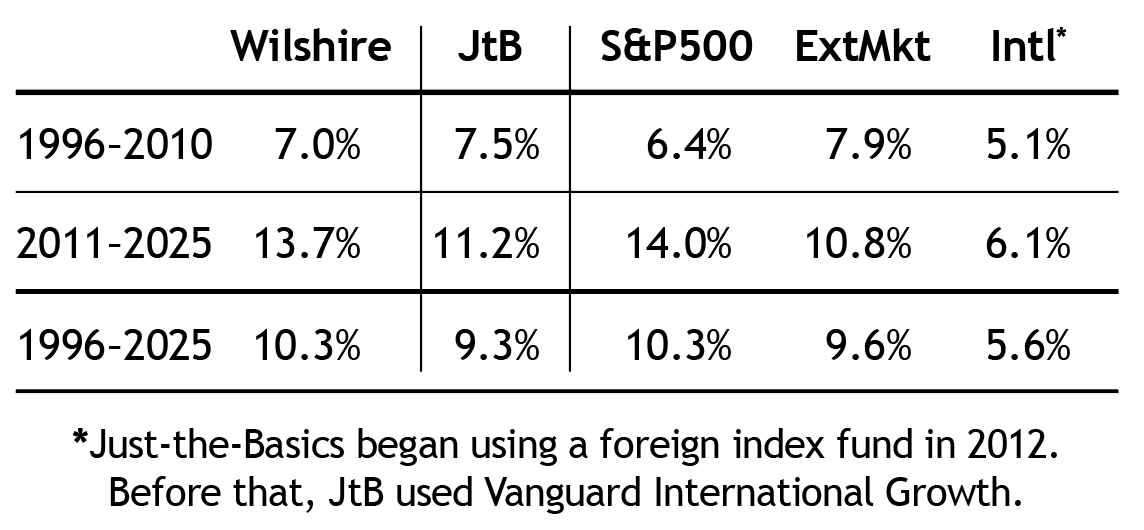
But breaking this 30-year period into two 15-year segments makes clear that the S&P 500 has performed much better over the past 15 years, while the Extended Market was stronger in the 15 years prior (1996-2010).
As our January 2025 article explained, we felt the balance of evidence warranted shifting JtB’s allocation to be more “market neutral” by reducing our allocation to smaller companies and boosting large companies. U.S. large companies make up roughly 75% of the U.S. market, so shifting JtB’s allocations to overweight the S&P 500 Index relative to the Extended Market (60% vs. 30% of JtB’s total allocation) made sense.
Foreign stocks: The true wild card
Whether to include foreign stocks is the big question that jumps out when evaluating JtB’s historical performance. The table above shows that foreign stocks have lagged U.S. stocks by a significant margin over the past 30 years, especially over the last 15.
So keeping international stocks when we reconfigured JtB’s allocations at the start of 2025 required a bit more faith in the market’s tendency toward long-term “mean-reversion.” That’s a fancy investing term that describes the tendency of an asset class to rally after a period of underperformance (or cool off after a period of superior performance).
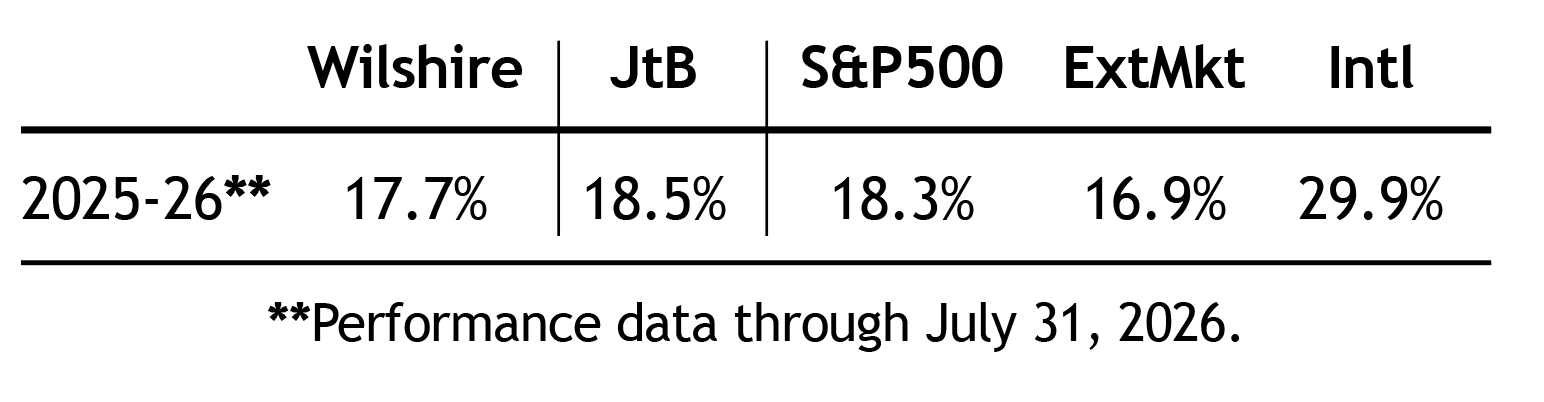
Fortunately, that faith has been rewarded so far, as international stocks have soared over the past 19 months, as shown in the next table. We’ve written before how U.S. and foreign stocks have tended to trade leadership back and forth every decade or two. In our April 2025 article, Time for Foreign Stocks to Shine?, we wrote about specific catalysts that could tip that balance back in favor of international markets. So far, that’s largely been accurate.
However, we did cut JtB’s foreign allocation from 20% to 10% in the 2025 reconfiguration. This reflects SMI’s evolving stance toward foreign stocks across all of our strategies. In SMI’s active strategies, we’ve shifted over time to include foreign stocks in larger allocations when they show strong momentum, and to exclude them entirely when they don’t. For those using JtB alongside SMI’s active strategies, we’re confident we can provide sufficient exposure to foreign stocks across the total portfolio when their performance warrants it.
Admittedly, for the relatively few SMI members who use JtB as their only strategy, its 10% allocation to international stocks may be a bit light. However, this is easily remedied if desired.
Obviously no one knows how foreign stocks will perform in the years ahead. Ultimately, which funds — and in exactly what amounts — to include is a question each JtB investor can decide for themselves. The Just-the-Basics strategy is easy to modify if an investor so desires.
However you approach it, including some indexed exposure in your portfolio can help take some of the “all-or-nothing” feeling out of investing with SMI’s active strategies, since you’ll know that part of your portfolio is simply riding along with the broad market. From an emotional standpoint, a “both/and” approach to strategy selection and portfolio construction can yield benefits beyond “either/or.”