

SMI’s strategies cruised into mid-year with strong performance relative to their appropriate benchmarks. Our stock strategies (Just-the-Basics, Stock Upgrading, Sector Rotation) all beat the S&P 500 Index’s total return of +10.2% during the first half of 2026. Dynamic Asset Allocation beat the +6.0% gain of a 60% stock, 40% bond indexed portfolio. And Bond Upgrading beat the Bloomberg U.S. Aggregate Bond Index (+0.6%) by a wide margin. A clean sweep!
We’re especially pleased with this first-half strength given that it wasn’t an easy market environment to navigate. Coming into the year, the market expected multiple rate cuts, a new “dovish” Fed chairman inclined to lower interest rates, and strong stimulus from last year’s “Big Beautiful Bill” to grease the economic wheels as this year’s mid-term elections approached.
Instead, we got a war with Iran and closure of the Strait of Hormuz, which spiked energy prices and sent inflation higher. This, along with the appointment of a more hawkish new Fed chairman than expected, combined to erase the expected interest rate cuts and replace them with potential hikes. And while there was a tax refund bump, much of it was absorbed by higher gasoline and other consumer prices.
The other major story of 2026’s first half was Artificial Intelligence and the enormous surge in semiconductor and memory stock prices (among other AI themes). In an ironic twist, the worst-case energy scenario (Iran closing the Strait) arrived but failed to produce the huge oil price shock most experts had long expected. Yet runaway computer memory prices and bottlenecks in computing components exerted their own upward push on prices as the intense buildout of data centers continued.
Given the surprises, twists, and turns of the year’s first half, it’s impressive that stocks managed such a strong gain. As is often the case, these returns weren’t distributed evenly. In June, SMI discussed the huge returns posted by semiconductor and other AI-related stocks (How to Handle a Bubble). On the other hand, several of the “Magnificent Seven” giant tech stocks that soared from 2023-2025 suffered significant pullbacks during the first half of the year, as did much of the broad software sector.
Just-the-Basics (JtB) & Stock Upgrading
SMI’s JtB strategy (+13.0%) outperformed the U.S. broad market (Vanguard Total Stock Market Index, +11.1%) during the first-half of 2026. While technology stocks have gotten all the attention in recent years, small-company stocks have quietly outperformed since late last year. The +18.4% gain of Vanguard’s Extended Market Index came in well ahead of the S&P 500 (VXF, +10.2%), as did JtB’s foreign component (VXUS, +14.0%).
Stock Upgrading had a very strong first half of the year, gaining +18.0%, well ahead of the U.S. broad market.
While several holdings contributed substantial gains during the first half of the year, the SMI 3Fourteen Full-Cycle Trend ETF (FCTE) was a notable turnaround story. After struggling along with other “Quality stock” strategies last year, FCTE posted an excellent +17.3% gain during the year’s first half. It surged +8.6% in June alone, while the S&P 500 fell -1.0%, making June the strongest relative-performance month for the Full-Cycle Trend model since February 2001.
Stock Upgrading’s experience with commodities over the past year provided a vivid illustration of the value of diversification. During the 2022 bear market, as stocks and bonds fell, commodities (along with energy stocks) were the only good diversifier. We saw a similar dynamic in March of this year as the Iran War began.
The chart below shows the performance of Upgrading’s commodities holding (SDCI) along with that of the S&P 500 Index over the past year. While the final 12-month performance gap wasn’t huge, commodities provided key diversification when the portfolio needed it most during March (as noted by the arrows).
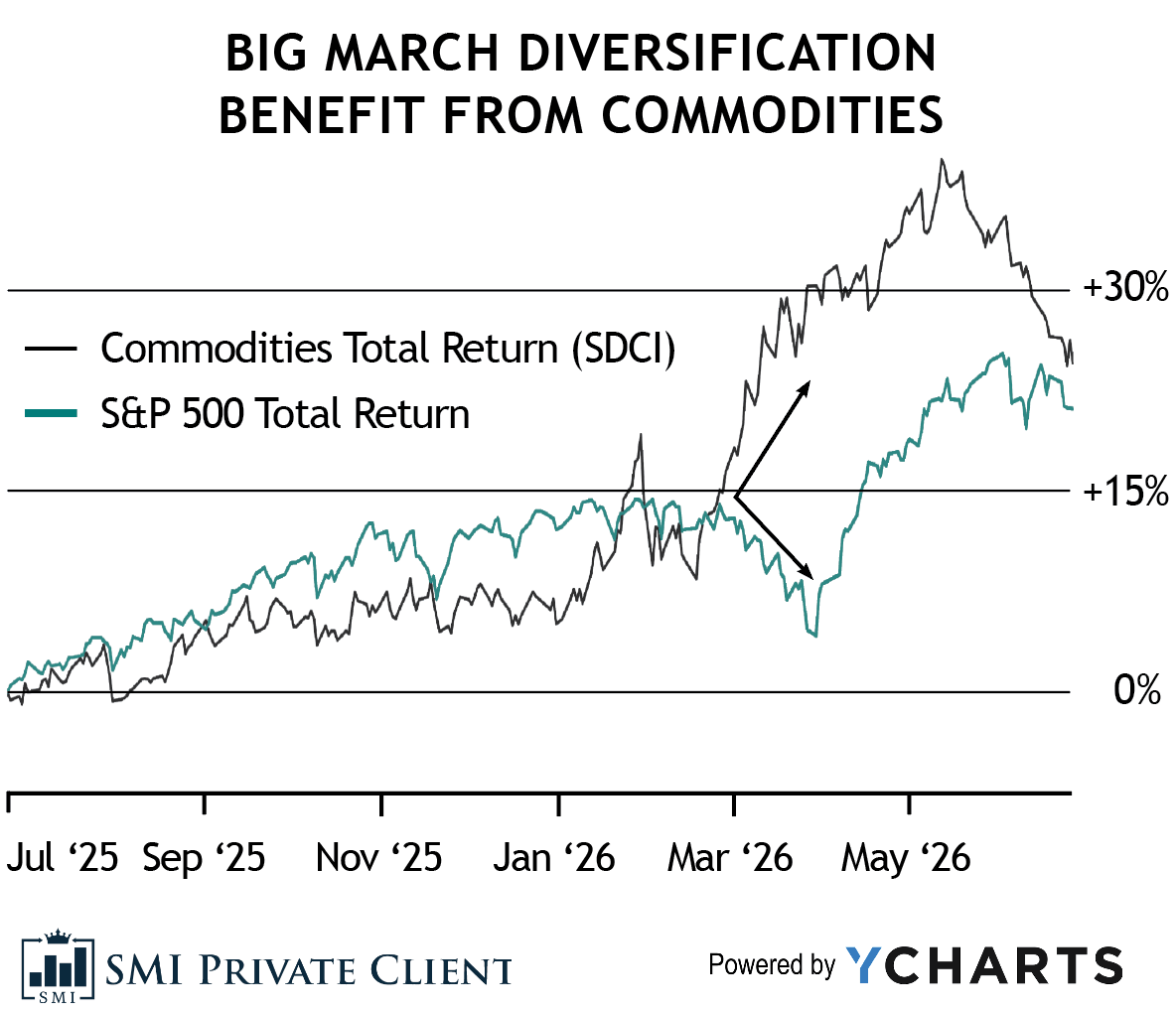
Owning investments that march to the beat of different drummers provides important benefits, smoothing out performance and calming anxious nerves when stock-heavy portfolios shift in the wrong direction.
Bond Upgrading (BU)
Bond Upgrading contributed the smallest absolute gains of SMI’s strategies during the first half of 2026. But on a relative basis, its performance was impressive. The bond market was largely flat at mid-year, with the Bloomberg U.S. Aggregate Bond Index up just +0.6%. Bond Upgrading, in contrast, gained +2.4%, outstanding relative performance for this new version of BU rolled out late last year.
Dynamic Asset Allocation (DAA)
DAA has been a star the past two years, as gold marched relentlessly higher. But after peaking in late January, gold fell roughly -25%. Even though that only took gold back to last November’s price level, it was enough to weigh down DAA’s returns during the first half of 2026.
Gold’s first-half decline of -8.6% limited DAA to an overall gain of +8.2%. That was still considerably better than the +6.0% gain of a 60% stock, 40% bond indexed portfolio, but could have been even better had gold not struggled. Still, it’s hard to complain about gold when DAA held it for 28 months, and even after this year’s decline, exited with a +91% gain.
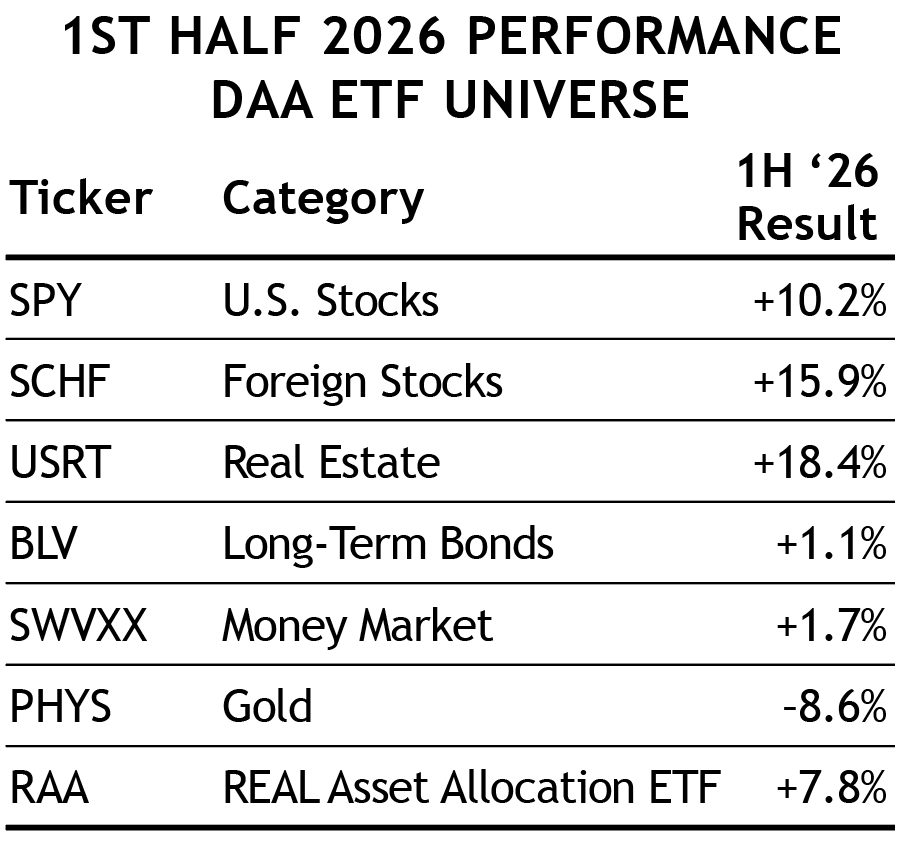
DAA’s stock positions fared well during the first half of the year, led by the strong +41.6% gain of EMXC — the Emerging Markets ex-China foreign holding that DAA held alongside its usual foreign developed-market position (Schwab International Equity, SCHF). Owning U.S. small company stocks (IWN/IWO) from February-June likewise improved on the returns from DAA’s standard U.S. large company stock position (SPY).
The SMI 3Fourteen REAL Asset Allocation ETF (RAA) — which comprises half of the DAA portfolio — had a solid first half, gaining +7.8% while providing significant diversification through its mix of 20 holdings. These allocations shifted considerably throughout the period due to the War and subsequent shocks to energy, commodities, and other asset classes. While it’s easy to look at RAA’s final return and conclude it wasn’t much different than DAA’s overall +8.2% gain, it’s worth noting that some of RAA’s positions would likely have provided significant protection had the market reacted more violently to the War and the potential for an energy shock.
Sector Rotation (SR)
Sector Rotation had a huge first half of the year, gaining +39.8%. The bulk of that came in May from what was then a new Semiconductor holding, which soared +25.6% — one of the strongest months ever for an SR holding. Of course, semiconductors have historically been a wild ride, and we’ve since given back some of those spectacular gains. This is par for the course — 3Fourteen Research recently noted that semiconductor stocks have already had two big corrections in this multi-year bull run, dropping -26% in one month during 2024 and -35% over two months in 2025.
So keep your seatbelt buckled as we navigate this wild semiconductor trade. With SR’s current holding down roughly -24% from its June high by late July, we’re still within the “acceptable correction zone” established in each of the past two years, but it's admittedly getting uncomfortable.
50/40/10 (with 60/40 stock-bond Upgrading)
This portfolio refers to the specific blend of SMI strategies — 50% DAA, 40% Upgrading, 10% Sector Rotation — that SMI has often discussed as a general guideline, or starting point, for member strategy allocations. In 2024, we started reporting this portfolio using a 60/40 split between Stock & Bond Upgrading within the 40% Upgrading allocation. This is a reasonable reflection of how most SMI investors utilize such a “whole portfolio” blend and is an example of the type of diversified portfolio we encourage SMI readers to consider. (Note: Blending strategies adds complexity. Some members may prefer an automated approach offered by SMI Private Client, an affiliated but separate company from the SMI newsletter.)
This version of a 50/40/10 portfolio posted a strong +12.8% gain in the first half of 2026, establishing a new all-time high for the model. With most of the individual components firing on all cylinders, that’s not surprising.
Conclusion
It’s been an excellent start to 2026 across the SMI strategies and we’re grateful. For the second year in a row, investors faced a major curveball — tariffs last year, the Iran War this year. In both cases, markets wobbled, but rebounded strongly.
It’s a good reminder that a well-defined process should default to staying invested and riding out most of the market’s waves. The SMI strategies have done that during both recent market swoons and then profited from the big rebounds that followed.
There’s always something to worry about regarding markets and today is no exception. The potential of higher interest rates threatens to upset the stock market, much as they did in 2022. As always, though, we trust the SMI strategies to navigate the market trend signals as they come.
No one we’re aware of expected the first half of this year to play out as it did, yet our portfolios performed well despite the twists and turns. Surprises will come in the second half of the year too, but we don’t live in fear of what the future may hold. For God has not given us a spirit of fear, but of power, and of love, and of a sound mind. (2 Timothy 1:7).