

An investor’s perception of the third-quarter market story depends greatly on which market and even which part of each market is focused on.
Investors have increasingly focused on interest rates and Artificial Intelligence (AI) as 2026 has unfolded. But the narratives surrounding these key themes haven’t been linear. Enthusiasm for AI during the second quarter turned to disbelief in July, only to swing back more favorably again by September. This rapid “on again, off again” cycling was tough on SMI’s trend-following strategies during the third quarter.
Meanwhile, interest rates had been rising gradually since the Iran War began at the end of February, but suddenly spiked higher during the third quarter. The widely followed 10-year Treasury yield jumped from 4.44% at the start of the quarter to 5.29% by its end.
That rapid rise produced significant investor angst, not just for bond investors, but also investors in smaller-company stocks. Smaller companies tend to be much more reliant on variable financing directly influenced by these rising rates, while the larger S&P 500 companies are able to borrow/raise money at lower, more stable rates.
This dichotomy between companies of different sizes created a situation we’ve seen several times since the start of the AI era in 2023 — a significant narrowing of market leadership back in favor of the largest tech stocks. While the quarter began with many tech stocks selling off sharply in July, by the end of September the largest tech stocks were increasingly the only game in town once again.
This created a significant disparity in performance at the stock index level, as the capitalization-weighted S&P 500 Index, driven by the performance of the largest tech stocks, gained +2.3% during the third quarter. In contrast, the S&P 500 equal-weight index fell -2.3%, while the small-company focused Russell 2000 Index was even worse at -7.2%. The 9.5% disparity between the S&P 500 Index and the Russell 2000 was the largest since Q1 2020 and second-largest since the late-1990s.
In other words, the third quarter was pretty tough for investors outside the largest tech stocks and the indexes heavily weighted to those stocks.
Trend-following strategies normally struggle with sharp changes in market trends. Both the S&P 500 and the Russell 2000 indexes set new all-time highs in mid-August. At that point, their paths diverged: the Russell 2000 immediately began to fall and dropped -8.7% from that point through quarter end, whereas the S&P 500 revisited those highs again in late September.
While the absolute losses were less severe in the bond market, the relative impact was perhaps even more dramatic. The +0.85% rise in the 10-year Treasury yield was the largest quarterly increase since 1994. Or, said differently, the third quarter was the 10-year Treasury’s worst quarterly selloff in over 30 years. Meanwhile, the 30-year Treasury yield temporarily climbed to its highest level since 2002.
Around the globe, the story was similar, as various sovereign yields spent the quarter creating various “highest since...” type headlines.
With so much going on beneath the market’s surface, it’s surprising the impact to most investors’ portfolios wasn’t more dramatic. Credit the role of indexing to the S&P 500 Index for much of that. With the largest index constituents continuing to hold up, the S&P 500 Index presented its best “nothing to see here” messaging, even as the sector trends whipped from positive to negative and back again, many stocks suffered significant declines, and the bond market wretched.
Just-the-Basics (JtB) & Stock Upgrading
As previously noted, indexers barely noticed the third-quarter drama. JtB posted a small -0.5% decline during the quarter, although the internal market disparities showed up clearly enough. The S&P 500 component gained +2.3% while the small- and mid-cap component (VXF) fell -5.7%. Foreign stocks (VXUS) were relatively benign at -0.4%.
Stock Upgrading was impacted more during the third quarter, declining -4.1%. As the Iran War appeared to move toward an end as the second quarter was closing, Upgrading responded to falling commodity prices by selling them and pivoting into small-company stocks. That turned out poorly as the war suddenly resumed. Commodity prices started rising again, and interest rates spiked higher, punishing small-company stocks as previously discussed.
By the end of the quarter, Stock Upgrading was reversing that trade, selling some of its small-company stock exposure and buying commodities again. But the rapid whipsaws in trends surrounding commodities and small-company stocks didn’t do Upgrading any favors.
Bond Upgrading
The most positive thing to say about Bond Upgrading during the third quarter is that it could have been considerably worse. This actively managed bond strategy lost -1.7%, while the Bloomberg U.S. Aggregate Bond Index fell more than twice as much at -3.5%. Year-to-date through the end of September, Bond Upgrading was nursing a +0.6% gain, comparing favorably to the index’s -2.9% year-to-date loss.
Dynamic Asset Allocation (DAA)
DAA posted a modest -0.8% third-quarter loss. One of the few bright spots this quarter came from the SMI 3Fourteen REAL Asset Allocation ETF (RAA), which gained +1.9%. Given that RAA always has at least some exposure to bonds, that’s a solid gain during a quarter when bonds were at their worst. The benchmark 60% stock, 40% bond portfolio we compare RAA against was slightly negative during the quarter, making RAA’s performance look even better. Year-to-date through the end of September, RAA was up +9.8%, more than three percentage points better than the +6.5% gain of the 60/40 benchmark.
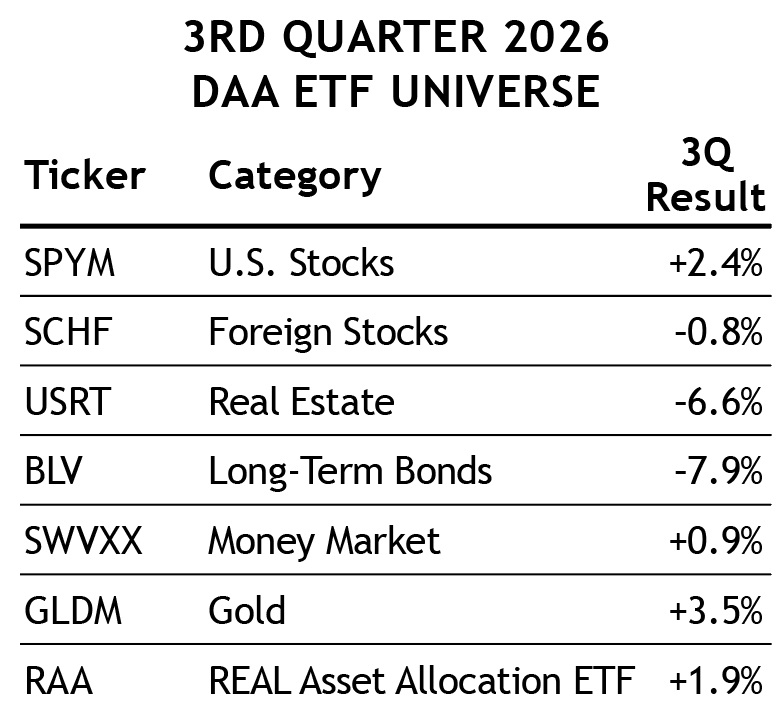
In the non-RAA half of DAA’s portfolio, its U.S. stock exposure — with much of that held in the S&P 500 Index — buoyed performance during the quarter. Avoiding bonds helped DAA as well, although it did have exposure to real estate, which was hit hard by the rising interest rate dynamic. (DAA sold its real estate exposure and pivoted to cash at the end of the quarter.)
Gold’s quarterly gain looks better on the surface than it does upon closer examination. Gold hit its low for the year in mid-July, rallied impressively over the next month, then declined substantially again through the end of the quarter. DAA sold its gold at the end of June (after owning it for 28 months) and hasn’t bought it again since. We suspect gold will become attractive again once interest rates peak and begin to subside — but no one knows when that will happen.
Sector Rotation (SR)
After gaining +39.8% during the first half of 2026, the on-off dynamic in the AI/semiconductor sectors hit SR hard during the third quarter. SR fell -27.5% during the quarter, with much of that coming during July as its semiconductor holding gave back its huge gain. The net result of that boom/bust semiconductor trade was that SR finished the third quarter up just +1.4% year-to-date.
50/40/10 (with 60/40 stock-bond Upgrading)
This portfolio refers to the specific blend of SMI strategies — 50% DAA, 40% Upgrading, 10% Sector Rotation — that SMI has often discussed as a general guideline, or starting point, for member strategy allocations. In 2024, we started reporting this portfolio using a 60/40 split between Stock & Bond Upgrading within the 40% Upgrading allocation. This is a reasonable reflection of how most SMI investors utilize such a “whole portfolio” blend and is an example of the type of diversified portfolio we encourage SMI readers to consider. (Note: Blending strategies adds complexity. Some members may prefer an automated approach offered by SMI Private Client, an affiliated but separate company from the SMI newsletter.)
This version of a 50/40/10 portfolio pulled back -5.1% during the third quarter, after establishing a new all-time high for the model shortly before mid-year. Sector Rotation’s steep third-quarter decline obviously weighed heavily, with more than half (-2.75%) of the -5.1% decline coming from the SR component.
Conclusion
While it’s easy to focus on concerns about a narrowing stock market, rising interest rates, and a host of other ever-present issues, there’s a more optimistic point of view to consider as well. The third quarter was one of the worst quarters for bonds and rising interest rates in the past 30 years…yet the headline stock indexes (most notably the S&P 500 and Nasdaq Indexes) set new all-time highs in early October. Contrast this to 2022, when rising rates contributed to a bruising -25% stock market selloff.
That said, rising interest rates remain an historic threat to financial market performance. History is filled with examples of Fed rate-hiking cycles eventually killing bull markets (while often also causing economic recessions). With the market and economy so tied to the AI investment theme, any signs of slowdowns there could also cause investors to reassess their positioning.
In short, the market environment grew more dangerous during the third quarter. While there are no signs of any imminent problems, as always we have to stay vigilant and responsive to the market’s signals as they unfold. To that end, it was interesting to see DAA raise cash at the end of the quarter, which has been rare in recent years (October is only the fourth month in the past three years that DAA has had a cash position).
As always, we invest knowing that market conditions can change at any time. As they do, our portfolios are always monitoring and standing ready to change as well.