

A cognitive bias is a "systematic error in thinking that affects one's decisions and judgments." Such biases affect us in many ways. In investing, they can lead to mistakes that cost money.
Researchers in psychology have cataloged hundreds of cognitive biases, illustrated below in a detailed graphic from a company called Design Hacks. You can also learn more about various biases from Biasopedia.com (yeah, that really is a thing).
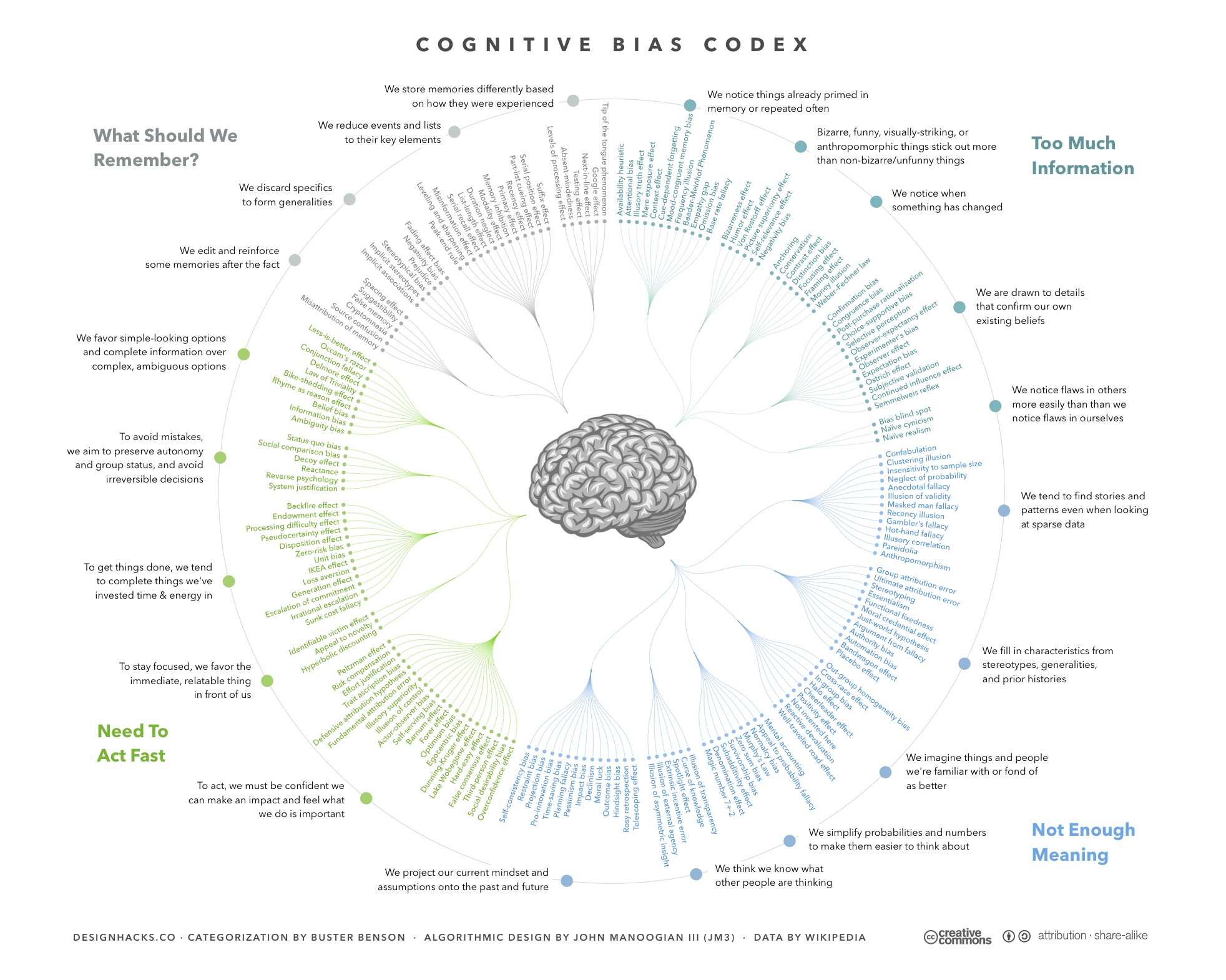
Click to enlarge.
SMI wrote about five of the most common biases that affect investors in our September 2022 issue: Loss Aversion, Anchoring, Recency Effect, Confirmation Bias, and Overconfidence Bias. Today, we tackle two more.
What's in the frame?
A bias that afflicts almost all investors (and non-investors, too!) is the Framing Effect. This means our decisions/reactions are influenced by how information about something is presented.

That's why, in video political ads, the "bad" candidate is shown frowning, often in grainy black-and-white, while the "good" candidate is in full color (and with a U.S. flag nearby).
The financial press does comparative framing too. Headlines make comparisons such as "Best performance since 2017" or "Worst since 2008." Are those comparisons helpful? Probably not. To find out, you'd have to delve into the numbers (and also determine what else was happening during the previous period). Most people aren't going to do that.
One type of investment-related framing that can be particularly harmful is the "narrow frame" that focuses attention on a small aspect of the overall situation. For example, putting too much emphasis on "what the market is doing today" is a narrow frame.
SMI encourages you to "expand" your frame. Remember that you are in this for the long haul. Remember, too, that each investment you hold is only one slice of a diversified portfolio. And keep in mind that your investment portfolio is but one aspect of your overall wealth.
Widening your frame of reference — regarding time horizon and wealth diversification — can help you persevere through (or ignore!) short-term reversals and volatility.
Too safe
Another bias to watch out for is the Zero-Risk Bias. The aforementioned Biasopedia offers a brief explanation.
[This bias is evident] when individuals prefer solutions or outcomes that offer no risk, even if the expected benefits of a riskier option outweigh the potential drawbacks.
Put another way, "People tend to gravitate toward choices that guarantee safety." This is why many people avoid the stock market and hold all their savings in low-risk investments such as savings accounts and CDs.
Safe holdings have their place, but tying up most of your money in low-yielding instruments (relative to the higher longer-term yields of the stock market) isn't really "no-risk." Indeed, there is a substantial risk of loss relative to inflation. So, in an attempt to reduce risk, people who fail to recognize the zero-risk bias can put themselves at significant risk.
Keeping biases at bay
No one is free of biases. However, it is possible to minimize biases when making investment decisions.
That's the goal of SMI's dispassionate, rules-based investing process. And it's why we provide practical tools such as allocation calculators, our Personal Portfolio Tracker, and the monthly Fund Performance Rankings report.