

In 1909, Merkel Landis of the Carlisle (Pa.) Trust Company had what became a great marketing idea. Knowing that many of his customers set aside money for Christmas spending, he launched the “Christmas Club” savings account. Customers were encouraged to make deposits throughout the year, but they couldn’t withdraw the money until December.
Even though Christmas Club accounts typically paid low rates and carried high fees, they soon became popular nationwide because they offered something people wanted: a dedicated account for a specific future need.
Roughly a century after Mr. Landis’s marketing success, online banks and credit unions began reintroducing the specific-purpose savings account. But they went further, allowing customers to set up and manage multiple such accounts, each dedicated to a particular savings goal.
Theoretically, savers don’t need to split savings into separate accounts. A saver who keeps excellent records would know, for example, that $356 in the family savings account is for new curtains and $1,442 is for driveway repair. But human nature being what it is, our record-keeping tends to be haphazard and our “mental accounting” fuzzy: “How much of this money is for our summer vacation and how much is for the annual life insurance premium?”
So, in the real world (the world that may not get accurately captured in a spreadsheet), multiple dedicated savings accounts can help.
The nuts and bolts
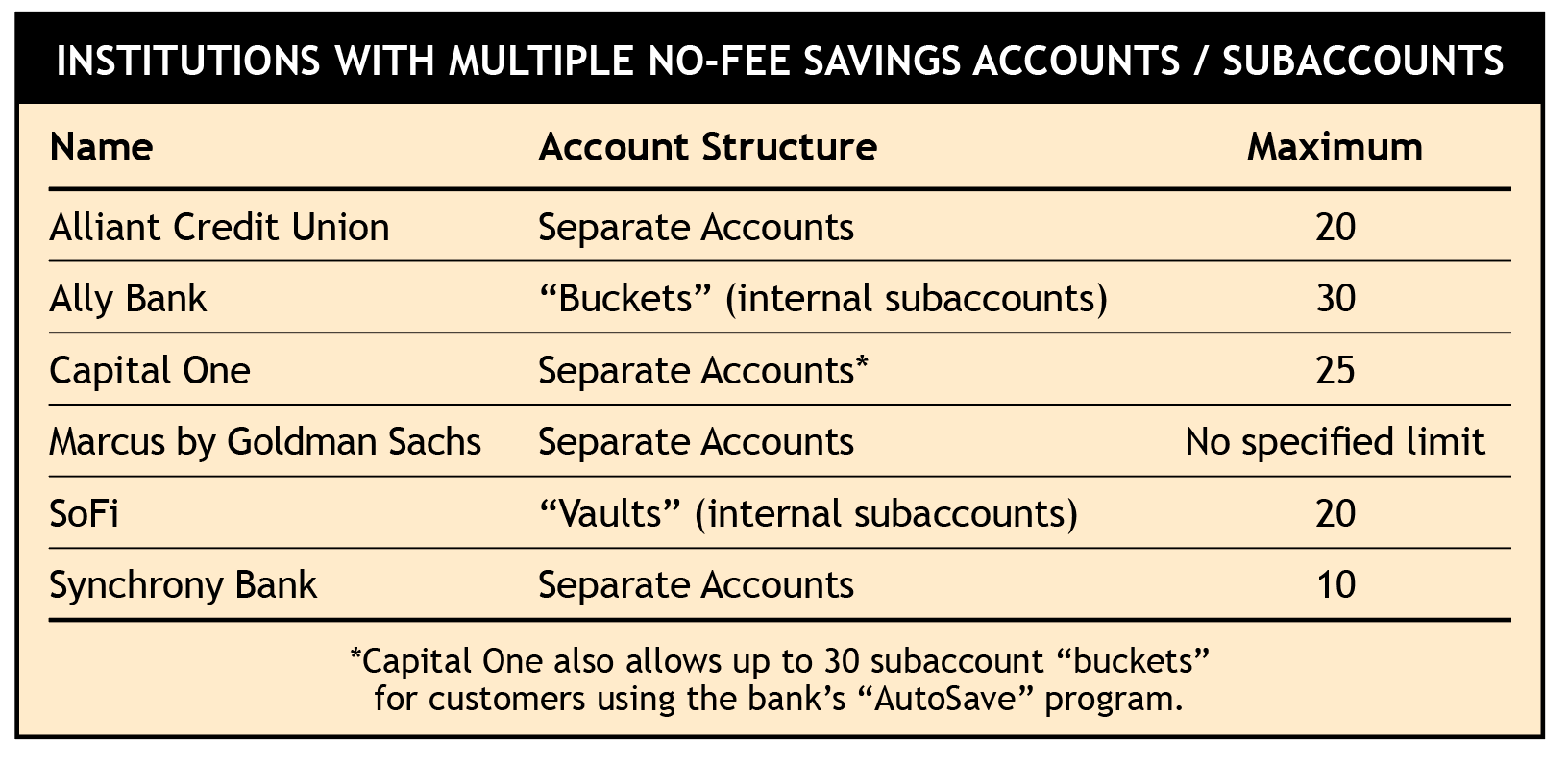
This list isn’t exhaustive, but here are a few financial institutions that make it easy to set up multiple accounts: Alliant Credit Union, Capital One, Marcus by Goldman Sachs, and Synchrony Bank. These institutions give each savings account a distinct account number, and most allow between 20 and 30 total accounts.
In contrast, Ally Bank and SoFi take a different approach. They use sub-account “buckets” or “vaults” tracked within a single account. This approach still enables users to easily see how much money they’ve saved toward a specific savings goal.
With each approach — i.e., distinct accounts and internal sub-accounts — the setup process is largely the same. After establishing an initial account, the customer can add dedicated accounts or earmarked sub-accounts. Typically, users assign each dedicated account or sub-account a descriptive “nickname.”
For example, you could choose nicknames that match specific budget items due every six or 12 months — such as “Car Insurance,” “Life Insurance,” and (if applicable) “Property Tax.” The monthly amounts deposited into each account would match the figures in your budget. For example, if life insurance costs $1,200 per year, your budget would require setting aside $100 monthly. That $100 would go into a dedicated “Life Insurance” savings account rather than into your checking account or general savings.
Echoing Merkel Landis’s “Christmas Club” idea, you may want to create a dedicated Christmas gift-giving account (or sub-account). By depositing one-twelfth of your projected holiday spending each month into that account, you could ensure that money needed for Christmas isn’t spent on something else during the year.
Automated transfers
To further streamline the use of earmarked savings categories, combine a multi-savings-account setup with automated transfers from a linked checking account (such as your regular checking account at your local bank). For example, you could set up an automatic transfer that sends $200 to a dedicated “Property Tax” account each month, and perhaps another transfer that deposits $150 each month into a “Family Vacation” account.
You can also easily transfer money from one savings account to another (or reassign it to a different “bucket” if using subaccounts). For example, if your vacation costs less than expected, you could transfer the remaining balance in your travel savings to your emergency savings. The transfer is as simple as typing an amount and tapping a button.
A powerful motivator
Setting up dedicated savings accounts or sub-account buckets, especially with automatic transfers from a checking account, creates a structure that ensures you have money available when a periodic bill or expense is due.
You’ll also be able to see at a glance how much is in each accumulation account (including your emergency fund) and know precisely where you stand relative to your goals. There’s one more benefit: As you watch your balances rise toward your savings targets, you’ll be encouraged to keep moving forward.
(Note: Bank and credit-union insurance typically covers “up to $250,000 per depositor, per institution, and per category.” If you have more than $250,000 in savings, use more than one institution.)