
Last month, SMI's Dynamic Asset Allocation strategy recommended moving a portion of holdings to "cash."
In investing, "cash" is a catch-all for several options, including money-market funds (MMFs) that invest in high-quality, short-term debt instruments and exchange-traded funds (ETFs) that may hold similar short-term assets.
(Note: You may encounter articles that refer to "money-market ETFs." Strictly speaking, exchange-traded products can't call themselves "money-market" instruments under SEC rules, even though their holdings may be similar to MMFs.)
Less liquid "cash" vehicles include Treasury obligations and brokered CDs. Outside of a brokerage account, "cash" options include bank savings accounts and CDs, as well as corporate "demand notes" offered by large companies such as Ford, GM, and Caterpillar.
When an SMI strategy calls for "investing in cash," we generally recommend a money-market fund (see our current DAA recommendations).
Money-market funds are not the same as bank-offered money-market accounts (MMAs), even though the names are similar. An MMF is a type of mutual fund, not a savings account. MMFs have a fixed share price (i.e., net asset value) of $1.00. Investors earn returns by receiving additional shares.
MMFs are considered low risk, and you can buy and sell them easily at any time without penalty.
Here is an overview of MMF options at SMI's recommended brokers. (Note: MMF tickers end in the letters "XX.")
Fidelity
Fidelity offers 11 in-house MMFs, both taxable and non-taxable (see a full list here). Even better, Fidelity investors can designate a money-market fund as the default option for their "core position," i.e., the account that holds the cash proceeds from sales plus any cash deposited with Fidelity that hasn't yet been invested. That helps because MMFs offer a much better return than the typical "cash sweep" accounts brokers use.
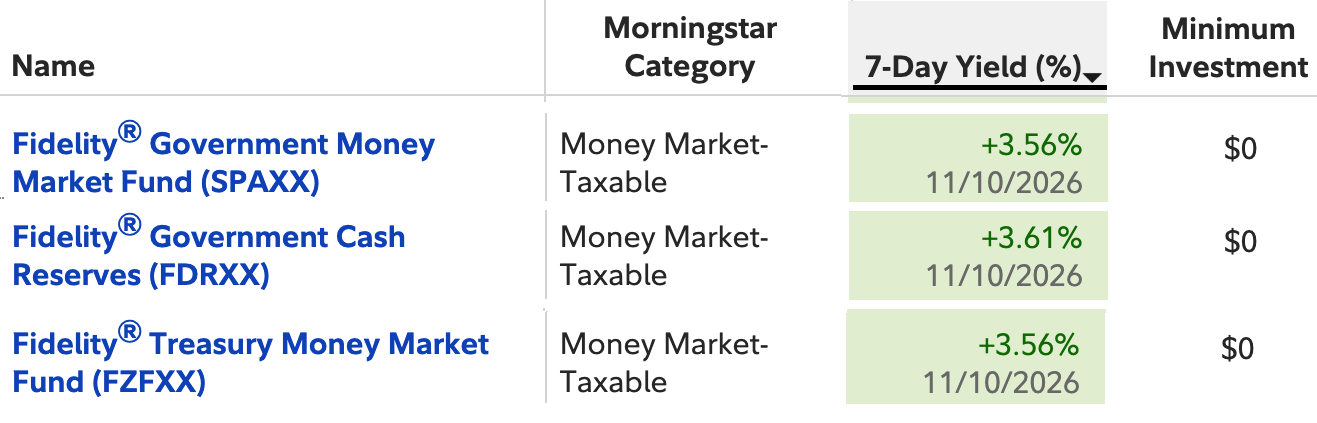
Most Fidelity investors can choose SPAXX (Fidelity Government Money Market Fund) as their core position fund. Some accounts (IRAs and HSAs) also have access to FDRXX (Fidelity Government Cash Reserves). Non-retirement account holders at Fidelity have one other option: FZFXX (Fidelity Treasury Money Market Fund).
As of Nov. 10, all three funds had similar "7-day yields" (i.e., a projection of what an MMF would yield over one year, based on its income distributions over the previous 7 days):
Choosing an MMF as your core position fund makes "going to cash" as simple as selling a holding and leaving the proceeds in the default account. It also simplifies redeploying your cash back into an equity fund when the time comes. (If you prefer to keep your core position separate from any cash you're holding for DAA, you could use a different Fidelity MMF for your DAA holding.)
If you're not sure which fund you're using for your core position, log in to Fidelity, select "Accounts & Trade," then "Account Positions." Click your core position to see the fund name. You'll also see an option to "Change Core Position." (If you prefer, a Fidelity rep can make the change for you — call 800-544-6666.)
Schwab
Unlike Fidelity, Schwab doesn’t allow an MMF to be the default option for sweep money. At Schwab, the default option for cash (for most customers) is a sweep account that pays an almost imperceptible 0.01%. By contrast, SWVXX (Schwab Value Advantage Money Fund) had a 7-day yield of 3.75% as of Nov. 10.
To invest in SWVXX (or any other Schwab money market fund), you must place a fund purchase, as with any other mutual fund. On Schwab's Trade screen, select "Mutual Funds" (or use an "All-in-One Trade Ticket") and enter SWVXX (or the fund you prefer) in the symbol field. Select "Buy" and enter the dollar amount you wish to invest.
Schwab lists its money market funds here. Select an "investor shares" fund unless you're investing $1 million or more!
E-Trade
In contrast to Fidelity and Schwab, which offer only in-house MMFs, E-Trade offers taxable and non-taxable money-market funds from many companies, including Allspring, Federated Hermes, and Morgan Stanley (E-Trade's owner). Vanguard MMFs are also available (minimum investment: $3,000).
Currently, most taxable funds available via E-Trade have 7-day yields above 3.50%. You can research all of E-Trade's MMF offerings here. Near the top of the left column, click "All Filters," then use the "Fund Category" dropdown to choose "Money Market."
Note: If you're an E-Trade investor, you may want to get in the habit of regularly transferring any uninvested cash to an MMF because, like Schwab, E-Trade still pays a paltry 0.01% on most sweep accounts.
Firstrade
Think of Firstrade as the brokerage equivalent of a "no-frills airline." It may be cheaper (in some ways) than the other guys, but the trade-off is more limited services and options. A salient example: Firstrade offers no money-market funds.
Firstrade customers who wish to "go to cash" should select an ETF such as BIL or BUXX. These aren't bad options. Some cash-equivalent ETFs are outperforming MMFs.
Vanguard
Vanguard investors have a sweet arrangement when it comes to "going to cash." VMFXX (Vanguard Federal Money Market Fund), with a current 7-day yield of 3.88%, is the default "settlement fund" for Vanguard account holders.
Of course, if you prefer to keep your "SMI strategy cash" separate from "uninvested cash," you can use a different Vanguard money market fund. The company's MMF offerings and current rates are shown here.
Note: For non-retirement accounts, Vanguard offers the FDIC-insured Vanguard Cash Plus Account, which currently yields 3.50%.