

One of the main themes of SMI's January cover article, Uncomfortable Regime Shifts, was that after ~35 years of declining interest rates from the mid-1980s until 2020, we may have recently begun a new "secular" (long-term) trend of higher interest rates.
That's potentially a bit confusing, given that we were simultaneously discussing how it was the rapid drop in interest rates in November and December of 2023 that propelled the big rally in asset prices.
This is one of those times when as investors we have to be able to hold two somewhat contradictory ideas in our head at the same time. The long-term (secular) trend in interest rates appears to be higher. But within that longer-term trend, there will still be short-term (cyclical) moves up and down in rates.
Let's look at some charts to illustrate.
Here's a chart of interest rates throughout 2023, specifically the 10-year Treasury yield.
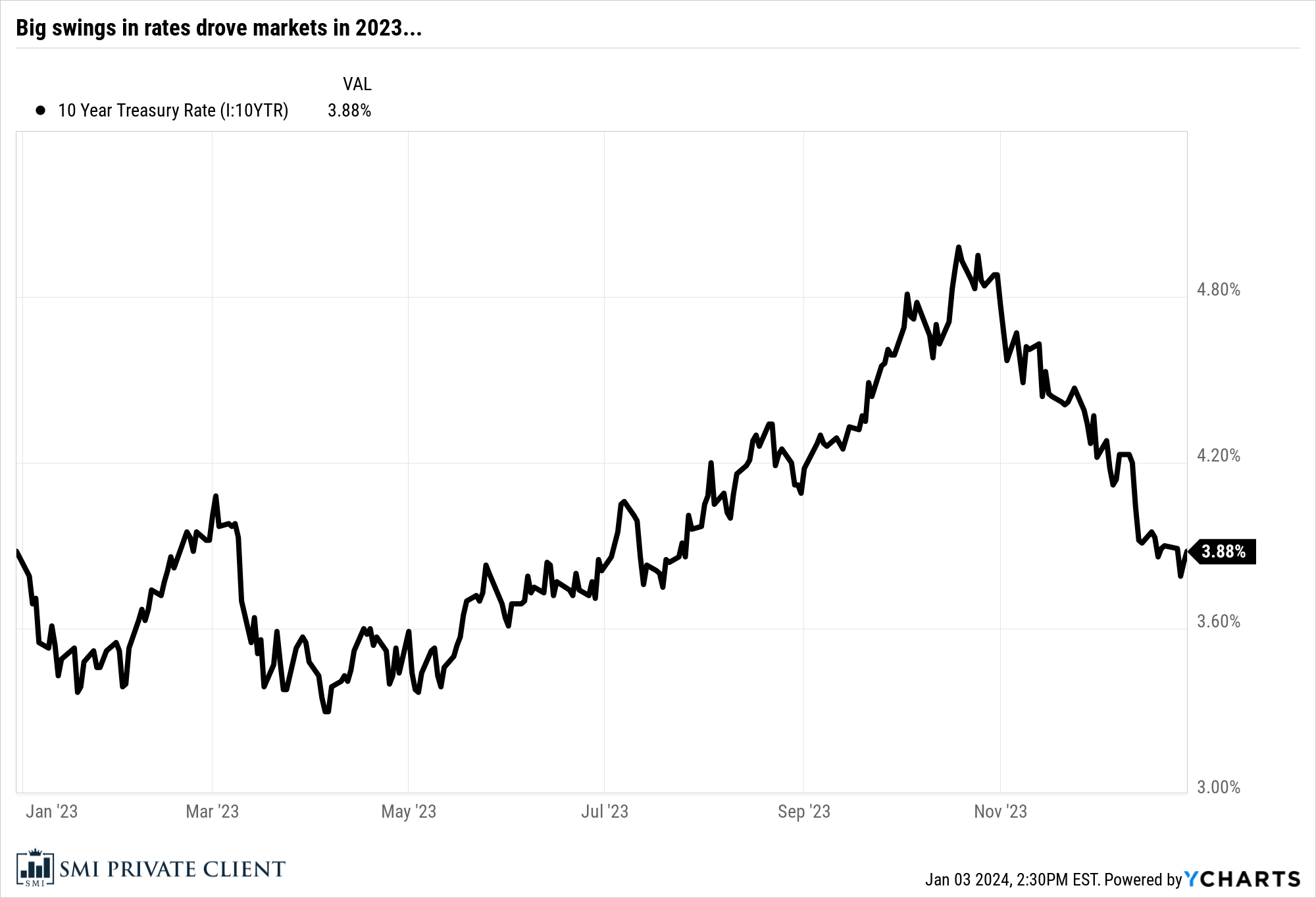
We can clearly see in this chart how yields had strong moves in both directions last year. Those strong moves were often the primary drivers of the stock market's direction. For example, stocks tanked from August-October as yields climbed toward 5%. Then stocks reversed course and soared as rates declined sharply during November-December. These were cyclical moves, primarily based on investor reactions to the changing odds of a recession.
Now let's pull back and look at a longer-term chart of the same 10-year Treasury yield.
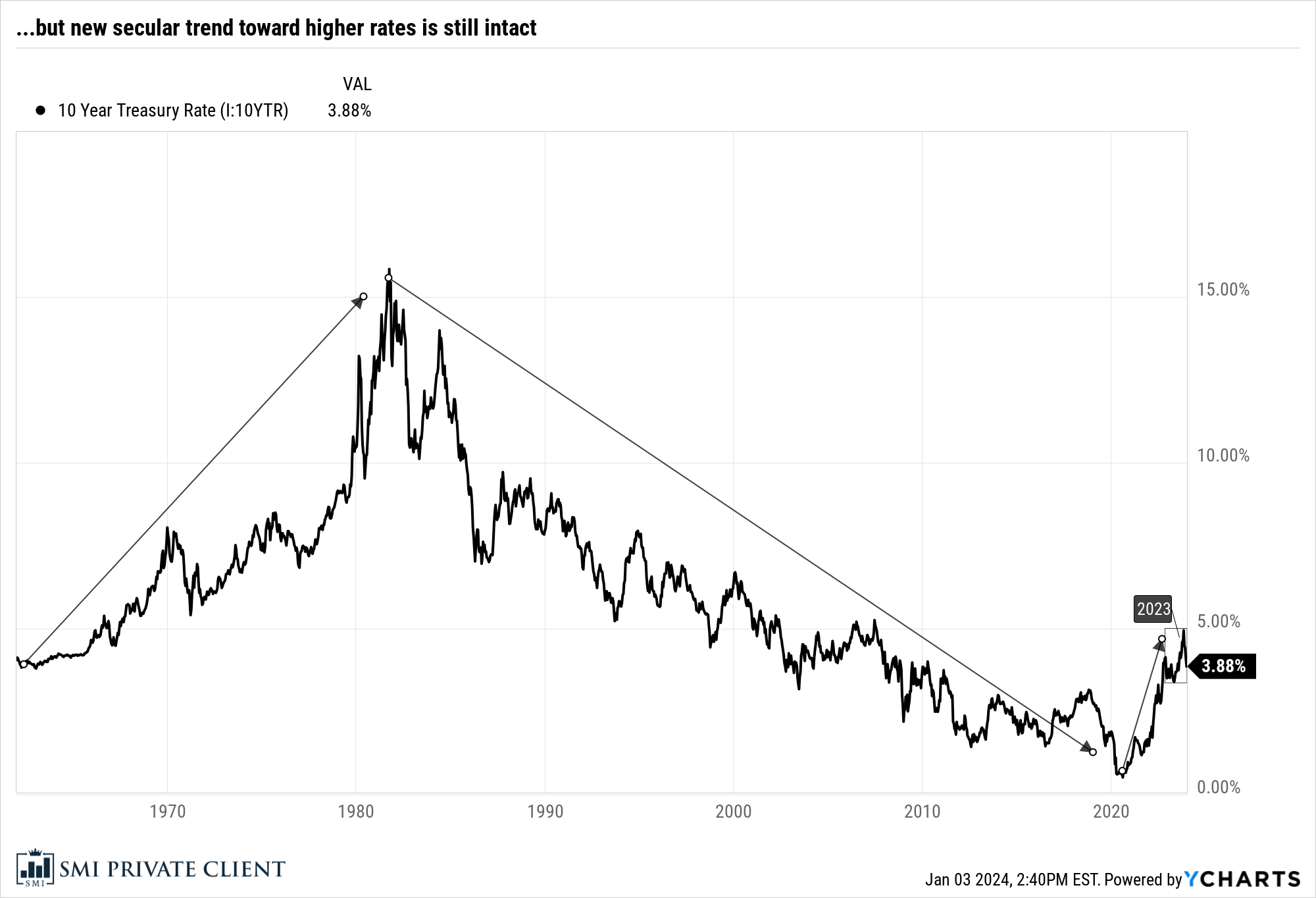
See the tiny little box in the bottom right corner? That's last year. Pretty insignificant in the broader secular scheme of interest rate moves. Yet powerful enough to still whip investors around pretty good throughout 2023.
The biggest takeaway from these charts, as well as perhaps the January cover article, is that once these interest-rate regimes shift, they tend to persist in the new direction for a long time — decades. It's too early to say definitively that this is the case, but that's what we're watching for.
Generally speaking, rising rate environments are much more challenging for investors than falling rate regimes. But they're also times when good active strategies are more likely to outperform.