

Years ago, SMI considered $25,000 to be the minimum amount needed to implement what was (at the time) our primary active investment strategy — Fund Upgrading. Even our basic passive strategy, Just-the-Basics, required a minimum investment of $9,000. For investors with smaller balances, “Getting Started” portfolios were available that showed how to begin investing with less. We compared them to training wheels on a child’s bike: “They’re helpful to get you up and going...but eventually you’ll outgrow them.” That was then.
Today, many of the roadblocks to investing with smaller amounts have been removed. For example, there are no minimums required to open an account at any of SMI’s recommended brokers. Many traditional mutual funds and, at one broker, exchange-traded funds (ETFs) may be bought and sold in fractional shares. As for commissions, they are largely a thing of the past. All of that means it has never been easier or less expensive to get started with SMI.
Schwab – the go-to broker for go-small investing
The starting point for investing a small amount is to choose the right broker. For this job, Schwab tops the list because it offers a wide range of traditional mutual funds with a $1 minimum investment. Here are more details about following each actively-managed SMI strategy at Schwab.
Fund Upgrading
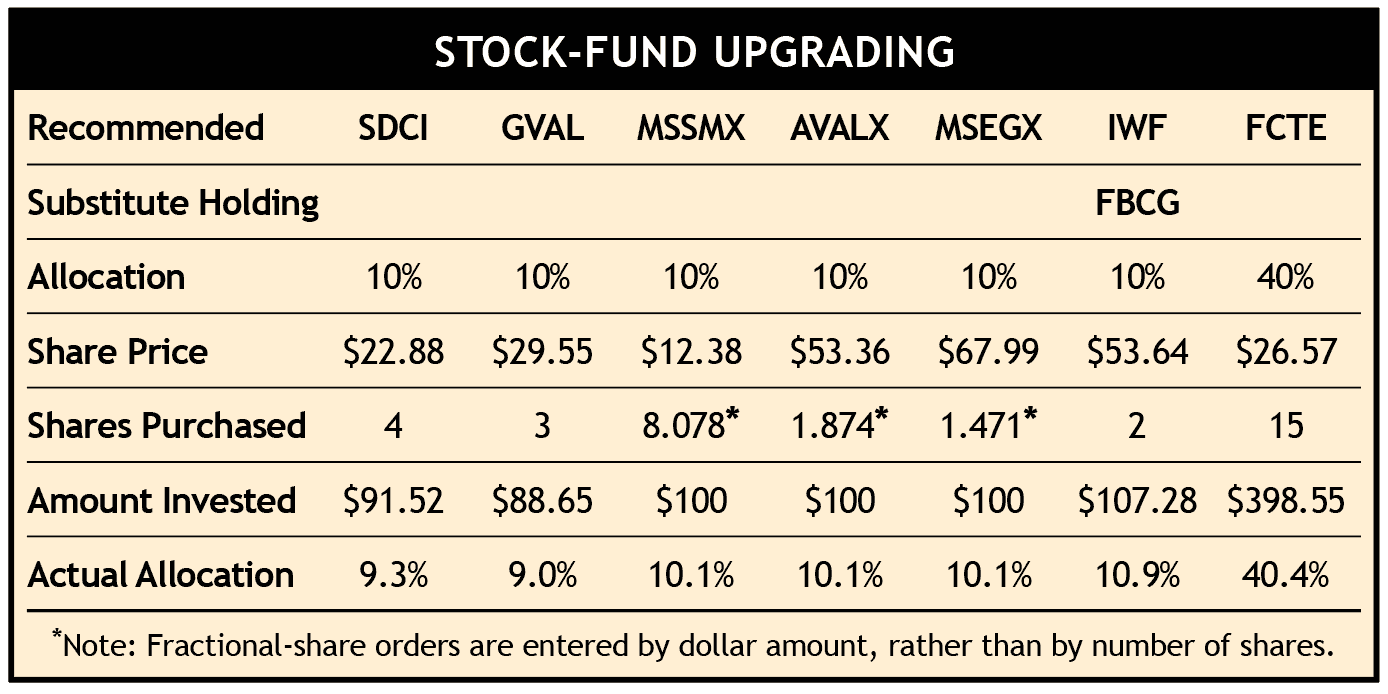
Upgrading has made greater use of exchange-traded funds (ETFs) over the years and Schwab does not allow fractional-share trading of ETFs. However, the combination of generally low ETF share prices and Schwab’s rock-bottom minimums for traditional mutual funds makes the broker well-suited for small Fund Upgrading portfolios.The table below shows how the strategy could be implemented at Schwab with about $1,000 using our currently recommended Upgrading funds. Keep in mind that MSSMX, AVALX, and MSEGX are traditional mutual funds, which can be purchased at Schwab for as little as $1. (At Fidelity, the minimum required investment for AVALX is $10,000!) All the rest are ETFs, so the minimum investment amount shown is the price for one share as of this writing.
IWF has a high share price right now — more than $450. To get around that, we used SMI’s Fund Performance Rankings to find a high-momentum substitute in the same large/growth category. We chose FBCG, whose share price is $53.64. Buying two shares overweights that holding slightly, but it’s okay if the allocations don’t line up exactly. The total investment turned out to be $986.
Dynamic Asset Allocation
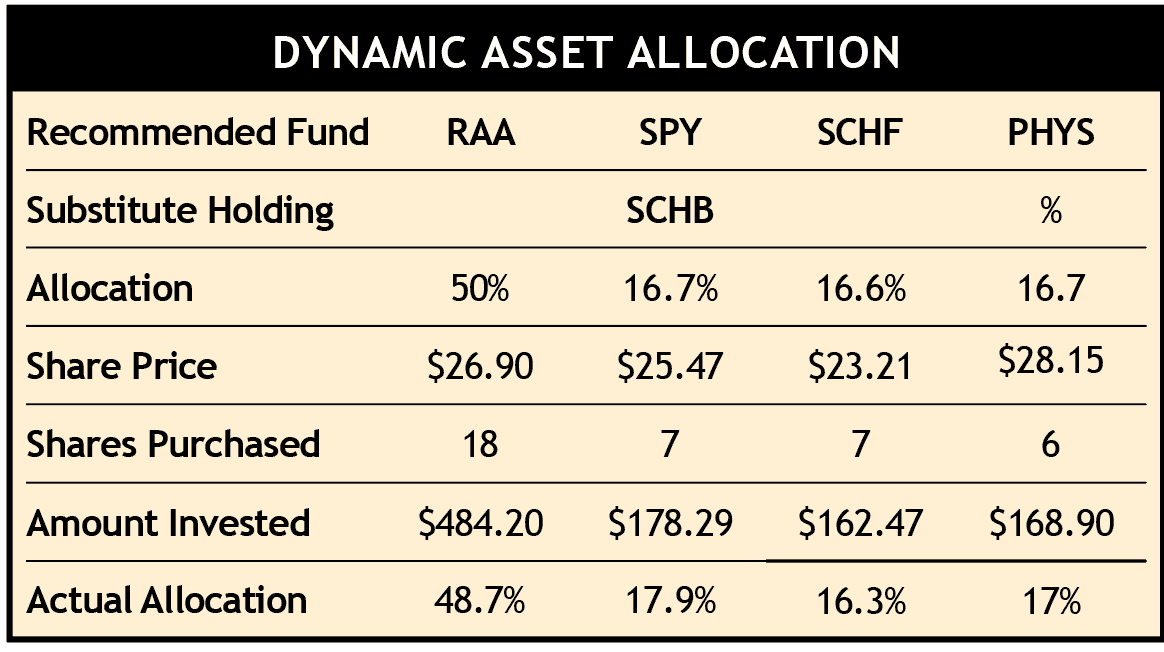
To follow DAA with $1,000 at Schwab, you would use the same process. List the recommended funds, their recommended allocations, and share prices. Then, determine how many shares to buy while staying close to the recommended allocations. The table below illustrates this, using the share prices of the recommended funds as of the time of writing.Note that instead of SPY, which has a very high share price, we used our recommended alternative (click on “Alternative Fund Options for DAA”), SCHB. The total investment ultimately came to $993.86.
Sector Rotation
Here, too, Schwab stands out for small-portfolio investors. While the current recommendation, FSDAX, is available at Schwab and Fidelity for just $1, the leveraged funds that are sometimes recommended by the strategy, such as SMPIX, can be purchased at Schwab for just $1, whereas Fidelity requires a $15,000 minimum. That makes following SMI’s blended 50/40/10 strategy (50% DAA, 40% Fund Upgrading, and 10% Sector Rotation) with a small amount of money relatively simple at Schwab.
Fidelity – second place for small-portfolio investors
Fidelity stands out among SMI’s recommended brokers for being the only one to offer fractional-share trading of ETFs. That makes it very simple to follow DAA at Fidelity with a small amount of money (in fact, you could follow the strategy with an insanely low $6!).
It is relatively simple to follow Fund Upgrading at Fidelity as well. The three currently recommended traditional mutual funds have high minimums, but you could find suitable alternative ETFs with the Fund Performance Rankings report. As mentioned earlier, though, Fidelity is not friendly to small-portfolio investors who want to use Sector Rotation.
The SMI indexing strategy, Just-the-Basics, could be easily implemented with small investments at all of SMI’s recommended brokers. However, to implement SMI’s actively managed strategies, investors starting with relatively small portfolios will be best served by using Schwab as their broker.
More accessible than ever
As you can see, as long as you pick the right broker, it’s never been easier or less expensive to invest with SMI. Getting started with a small dollar amount is a great way to build your knowledge of investing while also building your net worth.