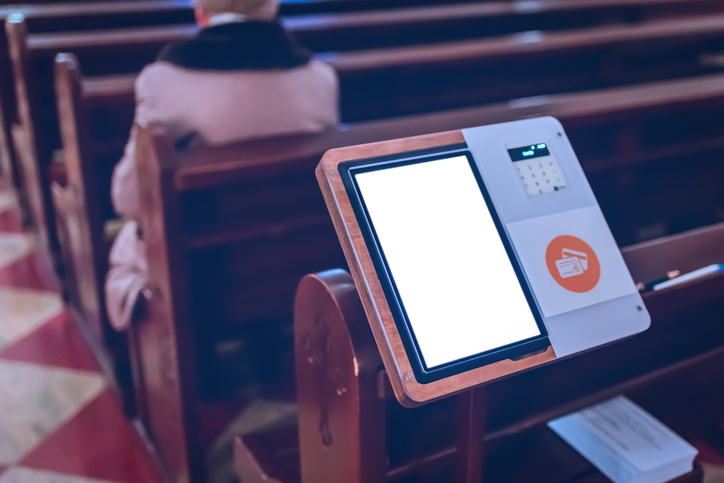

Most church donors still give via check or cash, but "digital" donations are making significant inroads. According to a new report from Ministry Brands, digital transactions now account for 42% of overall church giving.
Digital giving includes various types of electronic transactions, including those made via mobile apps, websites, direct bank transfers, "text to give," and "digital wallets" such as Apple Pay and Venmo.
Based on data from Ministry Brands customers (Ministry Brands operates multiple church-giving platforms), total digital giving rose 5.03% in 2024 compared with 2023, with nearly two-thirds of surveyed churches reporting an increase in digital giving year-over-year.
Interestingly, most of those churches report that giving via cash or check did not decline, suggesting that digital giving is facilitating an increase in giving rather than just enabling donors to switch from one giving method to another. Further, many digital donations are "recurring" — i.e., they are set up as automated transactions that repeat weekly, bi-weekly, or monthly. Predictable, recurring giving helps churches plan their budgets effectively.
Fee resistance
Although digital giving is becoming more widespread, many churchgoers remain resistant. According to a Ministry Brands survey of 1,020 pastors and church leaders, some givers have security concerns about electronic giving. Many are just unfamiliar with the technologies and platforms that facilitate the transactions.
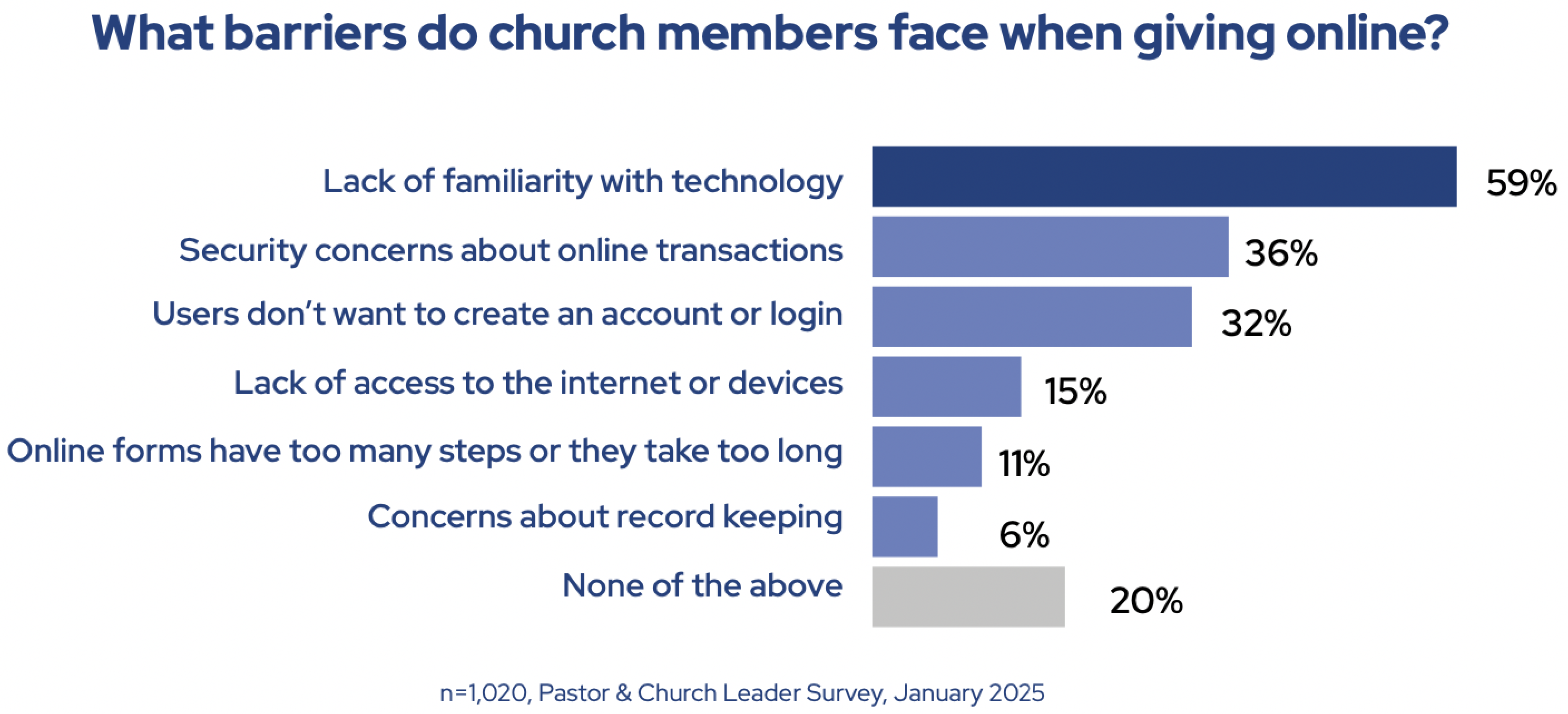
Interestingly, an obstacle not included in the survey is "fee resistance" (perhaps it falls into "None of the above"). Based on my conversation with church givers, fees are a significant issue. Many donors are reluctant to incur the fees — or have their church incur the fees — that accompany digital giving.
How much are those fees? On average, a credit/debit card donation carries a processing fee of around 2.9% plus a 30-cent transaction fee. Direct bank transfers typically cost less, averaging 1% plus $0.30 per transaction. (Direct transfers are called "ACH," which stands for Automated Clearing House.)
"Swipe fees" paid to credit card companies (mainly Visa, MasterCard, and Discover) account for much of the cost of credit and debit transactions. In other words, giving platforms pass these fees on to donors.
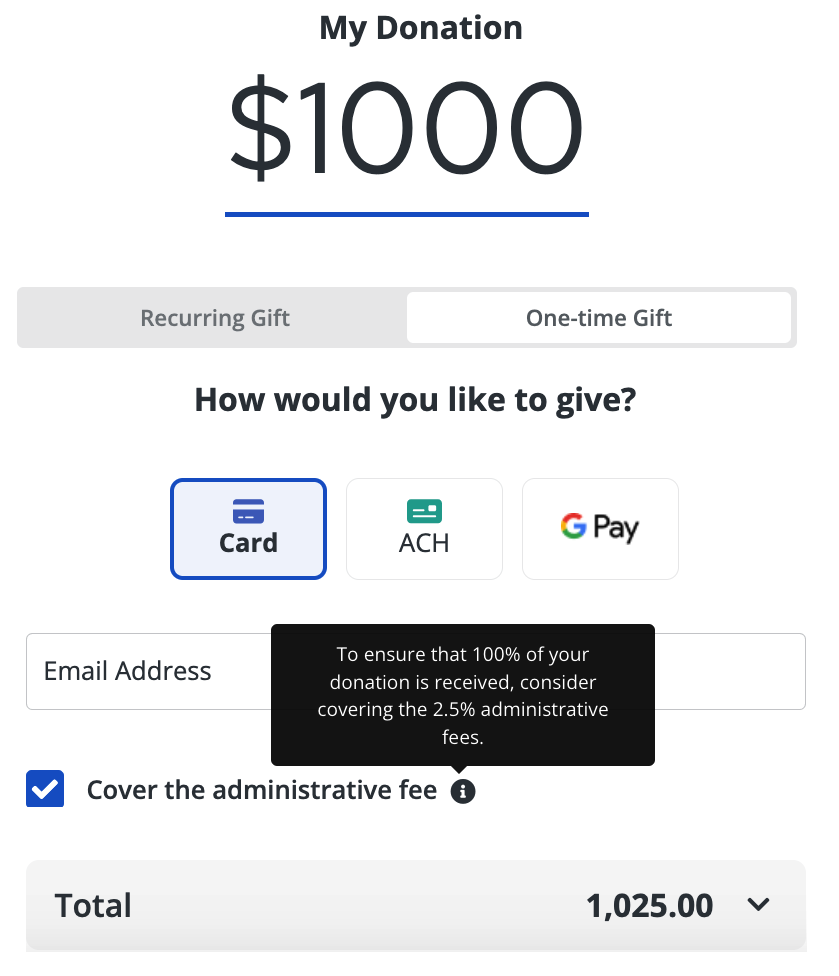
Churches often disclose the add-on costs when a donation is made and ask the donor to cover the fees in addition to making the donation itself. The screen capture at right (from my local church's website) shows a fee of 2.5% — or $25 on a $1,000 contribution.
Many donors are willing to pay extra to cover fees, but a significant percentage balks. Ministry Brands' testing of donor behavior found that "when users were asked to cover processing fees...there was a 39% decrease in donations."
A personal choice
There is no right or wrong answer to whether to give digitally. Obviously, giving platforms provide "value-added" benefits for churches, including easier donation processing, simplified recordkeeping, and (in some cases) seamless integration with church membership reports and communications.
In addition, providing digital giving options prompts some people to give who might not otherwise, especially younger people who grew up with smartphones.
Still, it's understandable that many (older) donors would prefer to drop a check in the offering plate than incur a fee to process a digital donation.
Weighing the options
If you give to your church electronically or are considering doing so, ask your church leaders about the digital-giving fee structure so you can do a cost/benefit analysis as a donor. (Be aware that even for churches using the same platform, fee structures can vary from church to church based on several factors, including church size.) For a rough overview of typical fees, see GivingFees.com.
As noted above, some giving platforms charge significantly less for ACH (i.e., direct from your bank) transactions than credit/debit transactions. For donors concerned about fees, using ACH may offer a means to donate electronically while lowering costs.
If you're dead-set against fees but want to use technology that automates recurring giving, consider an often-overlooked option: your bank's online bill-pay system. Banks typically make this service available at no cost to account holders. Your bank will issue a check on the date you designate (such as the 1st of each month) and mail the check to your church.
True, that approach isn't as seamless as a "pure" digital transaction, and it requires the church office to process a physical check. Still, it provides a way to set up automated, recurring giving at no cost to the donor.
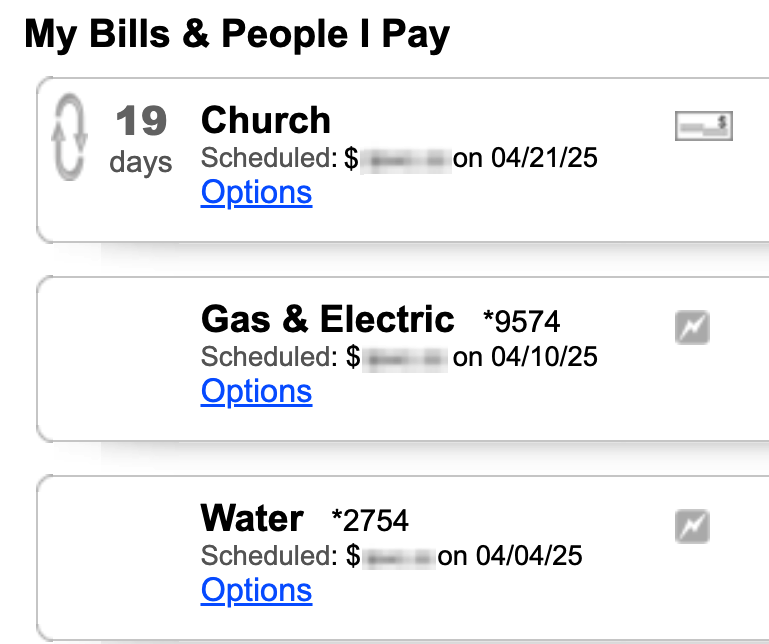
At the suggestion of a member of my church's finance committee, I recently began using the "bill-pay" option for my giving (see screen capture at left), even though I don't consider "giving" as a "bill" to be paid.
Frankly, I would prefer to put a check in the offering basket during worship. However, as a choir member, I have other obligations during that part of the service, so giving during worship has presented a logistical challenge. Enlisting my bank to mail contributions on a recurring schedule has proven to be a good solution.
Over to you: Do you use a digital-giving platform for church donations? If so, what type (e.g., browser, smartphone, kiosk, etc.)? Or do you still drop a check in the plate?