

One of the most significant challenges retirees face is turning their nest egg into a reliable, lasting source of income. It’s a daunting task from a number of perspectives. First, after many years of contributing to a retirement portfolio, many retirees find it uncomfortable to begin spending that money. Concerns about running out cause many retirees to spend far less than they could.
Second, there’s the dreaded “sequence of returns” risk. That’s the possibility that the market will tumble in the initial year’s of a person’s retirement. Having to sell depressed holdings for living expenses can permanently lower how much they can take from their portfolio for the rest of their retirement.
It would be so much simpler and more pleasant if we could turn back time and enjoy a defined-benefit pension, wouldn’t it? No investments to manage. No worrying about market returns or how long your portfolio will last. Just a regular check that shows up like clockwork — a “retirement paycheck.”
While traditional pensions aren’t likely to return, there is a way to manage a retirement portfolio that offers many of the same benefits. Yes, it will require more work than the pensions of yesteryear. But it’s a viable solution nonetheless. It’s the “bucket strategy,” and it’s possible to execute it using SMI’s strategies.
Bucket basics
With the bucket strategy, a portfolio is usually allocated across three “buckets” that span the risk spectrum: conservative, moderate, and more aggressive.
In a typical bucket strategy design, the first (conservative) bucket is filled with one to three years’ worth of living expenses (money that’s needed to supplement Social Security or other sources of retirement income). It is kept in a money market fund or conservative bond fund, protecting it from market declines. That enables it to provide a reliable “income.” The second (moderate) bucket, filled with another seven to nine years’ worth of living expenses, is invested a little more aggressively. The third (more aggressive) bucket is intended for longer-term needs.
Each year, some funds are moved from the second bucket to the first. And, when the more aggressive third-bucket does well, some of the gains are sold and moved to the second bucket. When the market does poorly, the third bucket is left alone, giving it time to recover.
Details, details
It all sounds good in theory. However, like so many things, “the devil is in the details,” which are often sorely lacking in articles about the bucket strategy. How exactly do you know when to transfer money among buckets and how much?
Enter SMI Private Client (SMIPC), an affiliated but separate business from the SMI newsletter. SMIPC recently introduced a way to operationalize the bucket strategy with a service called Cash Flow Reserve. Using a blend of SMI strategies, it follows the principles of the bucket strategy to deliver reliable retirement paychecks.
Newsletter subscribers could do something similar. Here’s how.
SMI’s two-bucket strategy
The first step is to determine your optimal asset allocation using SMI’s Risk Tolerance Quiz. Let’s say you have a $1.2 million portfolio and your optimal asset allocation is 60% stocks and 40% bonds. Using principles from Cash Flow Reserve, you would put 60% in whatever combination of Dynamic Asset Allocation, Stock Upgrading, and Sector Rotation you’re comfortable with — let’s use 75%/20%/5% — and 40% in a modified version of Bond Upgrading.
If you want to withdraw $60,000 in year one of your retirement, your $1.2 million portfolio could look like this:
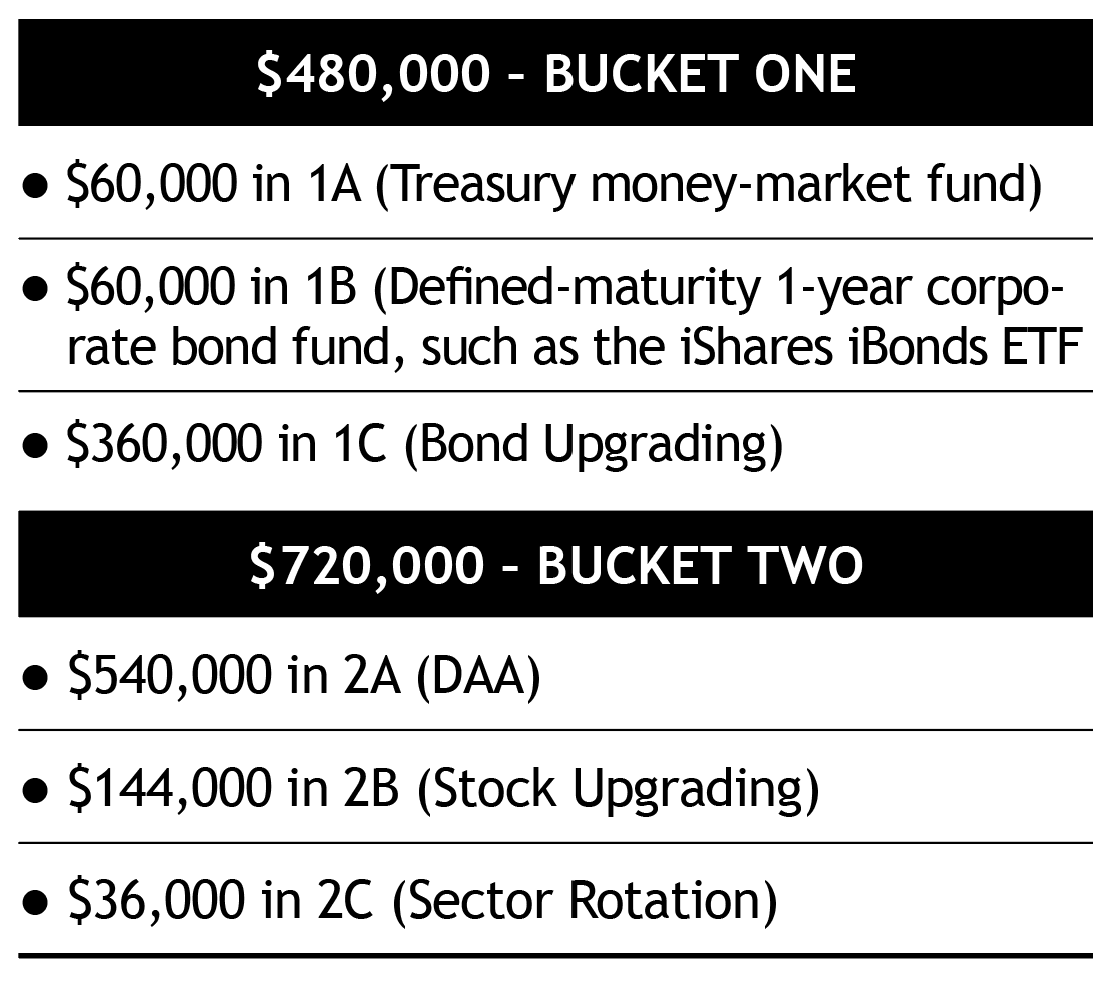
As you can see, each of the two Buckets have three “sub-buckets.” In Bucket One, 1A is super conservative and is the source of your first year’s retirement paycheck. 1B is still conservative, but should generate a slightly better return. 1C is invested in the four funds used in regular Bond Upgrading.
After one year, 1A has been emptied out and used for living expenses. 1B’s holding is sold and transferred to replenish 1A. Its return should allow for an inflation increase in your second year’s retirement withdrawals. Each year, another inflation-adjusted year’s worth of living expenses is sold from 1C with the proceeds used to buy a new one-year corporate bond fund in 1B.
As for Bucket Two, in an up year you would sell some of the gains and transfer the money to 1C. While deciding how much to sell is a bit of a judgment call, the overarching goal is to keep Bucket One close to its 40% target allocation. You should also sell in a way that rebalances the sub-buckets more closely to your intended strategy allocations.
In a down year, you would leave Bucket Two alone, giving it time to recover. You already have a decent cushion in 1C and a down year in the stock market may mean an up year for Bond Upgrading.
Another factor to keep in mind is required minimum distributions. Make sure the retirement paycheck you’re drawing is sufficient to cover your RMDs. If your portfolio consists of traditional and Roth IRAs, use your traditional IRA for Bucket One.
You have options
Clearly, this is a lot more work than opening a check each month from a defined-benefit pension plan. Having this process automated and handled for them is a significant benefit for SMI Private Client investors. However, if you’re willing to put in the time, this article can help you manage a bucket strategy on your own, thereby providing yourself with a reliable retirement paycheck.
To learn more about SMI Private Client’s Cash Flow Reserve, visit www.smiprivateclient.com/cash-flow-reserve.