
I typically get some neat stuff for Father’s Day. Dinner at one of my favorite upscale restaurants with all three sons. Offers to come over and help with a DIY project. Tickets for a night out at the movies together. As my sons know by now, time spent together is my favorite gift.
But it’s not only the times we share. What makes them meaningful is the attitude with which they approach them. They are entered into gladly, joyfully, with hearts full of love for me. It’s the special relationship I have with each son that gives each gift its significance. The gifts are expressions of their love. If they weren’t, they’d just be ordinary occasions, things I could have done on my own.
The gifts are desirable because the relationships that prompted them are precious. This truth helps us understand why our heavenly Father looks at our obedience and the attitudes of our hearts when deciding whether our gifts to Him are acceptable.
The acceptability of any gift depends on the acceptability of the giver. This is why understanding the Spirit-controlled life is so basic to being able to give in the kind of generous and cheerful way that God delights in.
As we explain in our mission statement, SMI exists to help Christians understand and apply Biblically-based principles for making spending and investing decisions in order that (1) their future financial security would be strengthened, and (2) their giving to the cause of Christ would accelerate. We want to help you have more so you can give more.
God wants you to mature in this area of giving just as in other dimensions of the Christian life: “Just as you excel in everything — in faith, in speech, in knowledge, in complete earnestness and in your love for us — see that you also excel in this grace of giving” (2 Corinthians 8:7). So, how are you doing? Are you growing? Are you excelling?
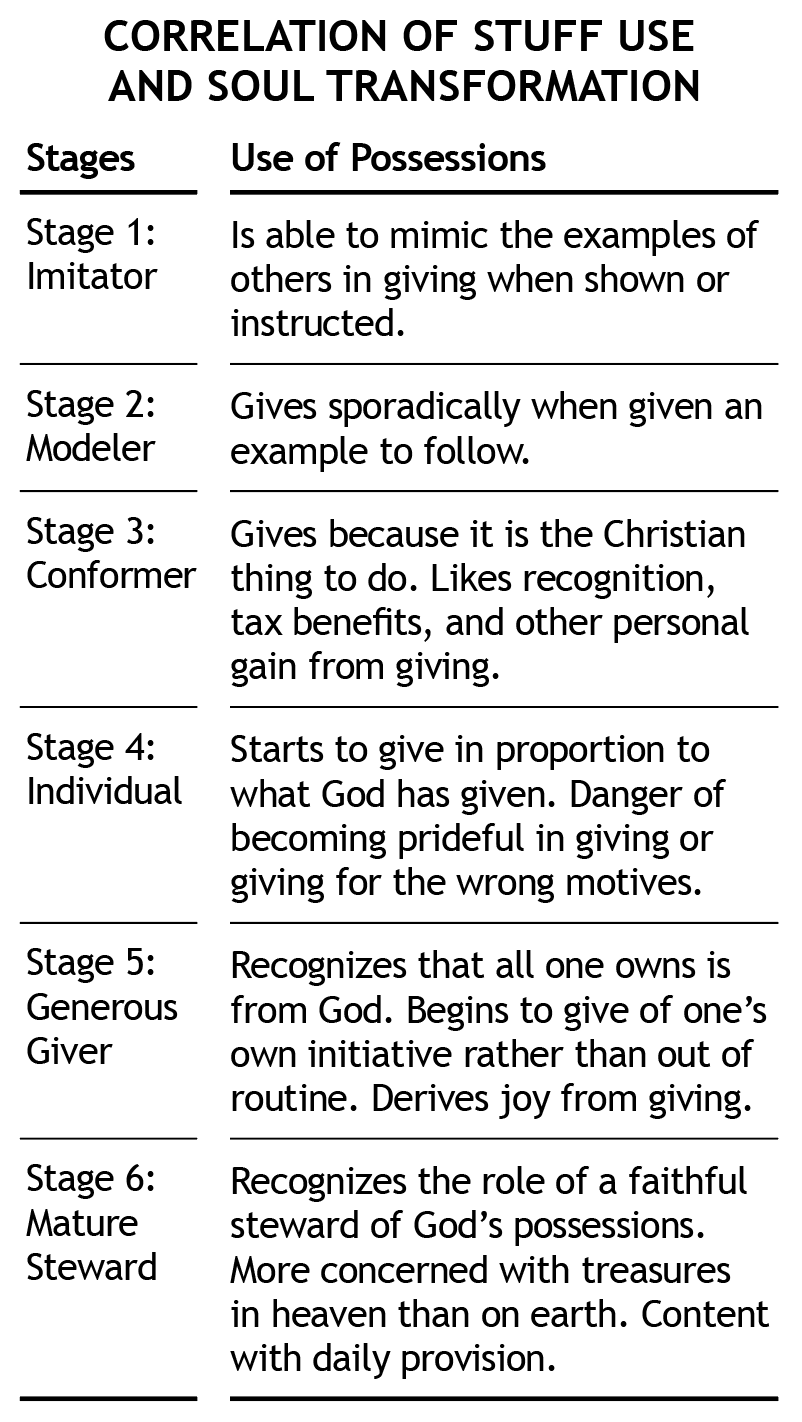
To help us get a handle on how we’re progressing, the table on the right was developed by Wesley Willmer, former Chairman of the Board of the Christian Stewardship Association. In his 2020 book Stuff & Soul, he explains: “This is not a personality test.... The stages of faith [shown in the left column] don’t try to tell you who you are but where you are.... Understanding where you are in your faith journey can help you continue to progress ‘to the whole measure of the fullness of Christ’ (Ephesians 4:13).”
In his earlier book, God & Your Stuff, Willmer noted that moving from one faith stage to another “is not automatic. It is very possible, and even probable, that a person becomes stuck and remains in a stage for his entire life.... It is also possible for someone to become a Christian in midlife or later and to progress very quickly, to even seemingly skip stages as he matures in his faith and use of possessions.... We all make choices each day as to which trail we will follow.”
Willmer’s books provide much food for thought and should prompt any serious believer toward introspection about “where” they are on their faith journey.
However, I found one area curiously underemphasized in Willmer’s ongoing exploration of the connection between spiritual health and material possessions. When discussing motivations for giving, Willmer says that giving generously fulfills our moral and biblical obligations, helps meet the needs of others, weakens our dependence on material possessions and strengthens our dependence on God, enhances our own spiritual growth, and benefits us personally by gaining eternal treasures.
Certainly, all of that is true, but I’ve found that none motivates me as much as this simple truth: When I give lovingly, cheerfully, and generously, it gives the Father pleasure. It’s the perfect gift for the Dad who has everything.