
The stock prices of the top handful of tech giants have grown so much (and so fast) this year that Nasdaq Inc. will implement a "special rebalance" of its Nasdaq-100 index next week to diminish the influence of six stocks: Microsoft, Apple, Nvidia, Amazon, Tesla, and Alphabet (Google).
Together with Meta (Facebook), those companies constitute the "Magnificent Seven" — a group of stocks that has seen remarkable run-ups this year.
A Nasdaq article (PDF) on "concentration risk" offers an overview of why too much of a good thing isn't necessarily a good thing.
Benchmark equity indexes such as the S&P 500® Index and the Nasdaq-100® Index are weighted by market capitalization — the more valuable a company, the more influence it has on the overall index. As a result, the performance contribution of the largest companies can significantly exceed those of smaller constituents.
Another way of saying this is that a select few stocks can have an outsized effect on the index.
Why is that a concern? Because more than a dozen popular index funds track the Nasdaq-100, including the QQQ, the second-most traded ETF on the U.S. stock exchange. This Morningstar graph illustrates how QQQ has become increasingly concentrated since the start of 2023.
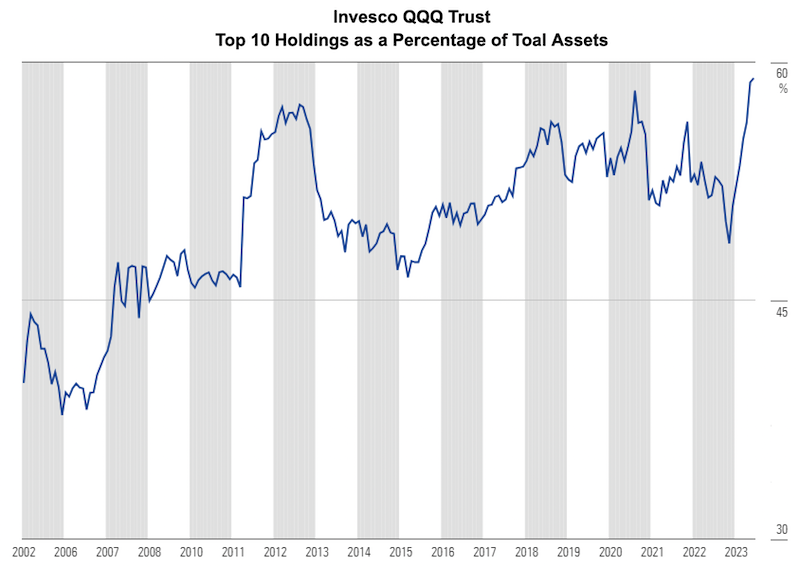
As Bloomberg's John Authers notes (soft paywall), "Tracking the Nasdaq-100 now unavoidably means placing a big bet on a handful of giant tech names. Such narrowness strips the index of diversification to a point where its providers had to take action."
Although federal regulations require "diversified" actively managed funds to limit the aggregate weight of their largest holdings, passively managed index funds don't face the same government-imposed requirements.
Still, Nasdaq has in-house allocation rules for the Nasdaq-100, described here (PDF). The internal guidelines say "no security weight may exceed 14% of the index." Apple and Microsoft are near that territory, with each accounting for more than 12% (as of the end of last week).
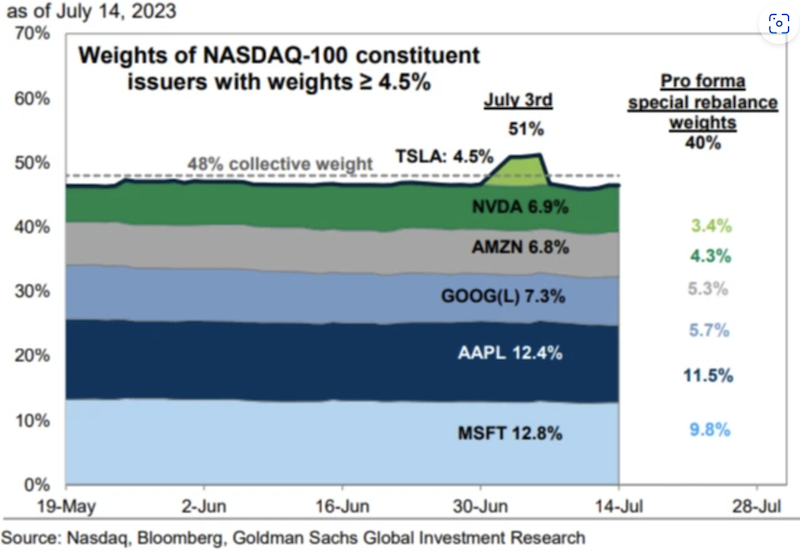
Further, Nasdaq's rules call for keeping the combined weight of the five largest components of the index at no more than 40%. Lately, the top five have been pushing close to 50%, as shown in this chart from Goldman Sachs.
Getting back in balance
Rebalancing the Nasdaq-100 will affect QQQ — and every other fund that tracks the index — as the holdings of big tech are reduced (the new target weights are shown in the graphic above) and the holdings of other stocks are increased. No stocks are being added or removed.
But it's not just Nasdaq-tracking funds that will be affected, as Morningstar points out.
Most investors in U.S. stocks will be at least indirectly affected by the rebalance. Billions of dollars of stock will be bought and sold in response to the rebalance.
Luckily, the selling will occur in some of the world’s most liquid stocks, meaning the price impact should be limited. Markets may experience a bit higher volatility as the changes become known and the market repositions.
Not likely to interrupt the trend
The rebalancing of the Nasdaq-100 is getting a lot of attention from pundits and the press, but most investors likely will be best served by not doing anything in anticipation of it.
Although no one can project the precise impact, the rebalancing seems unlikely to affect tech's run-up, which is largely fueled by massive amounts of money coming into index funds from regular retirement account contributions. As that money flows in, the biggest funds in market-weighted indexes get bigger.
That tech trend may falter when (and if) a recession takes hold and/or the artificial-intelligence boom wanes. But we're not there yet.
As we have often stressed, SMI follows trends rather than trying to anticipate them. In response to observable data, our strategies began shifting toward greater stock exposure months ago, starting with DAA. More recently, Fund Upgrading has embraced the tech boom of 2023.
We're not yet convinced a 2023 recession is off the table, but for now, the trend is what it is. A "special rebalance" of the Nasdaq-100 isn't likely to alter its direction.