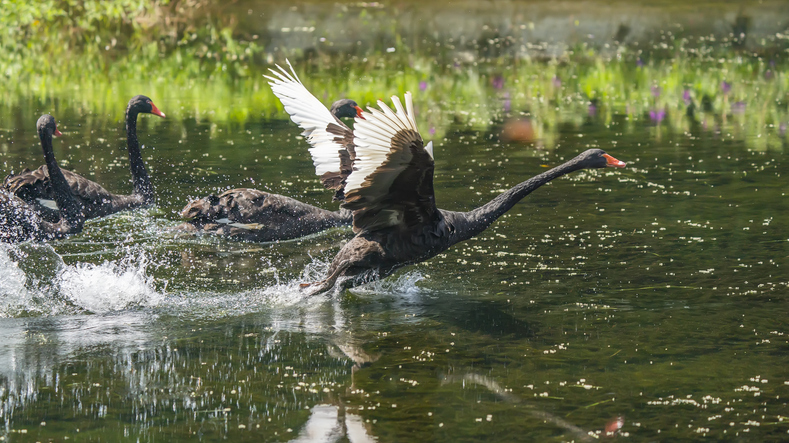

Nearly 2,000 years ago, the Roman poet Juvenal created a lasting metaphor when he referred to a rare thing as being similar to a "black swan.” Most swans, of course, are white. But black swans do exist (mostly in Australia).
In his 2007 book, The Black Swan: The Impact of the Highly Improbable, economist and investor Nassim Nicholas Taleb popularized the black swan concept, discussing the extreme impact of rare and unpredictable events. "The inability to predict outliers," he wrote, "implies the inability to predict the course of history." Obviously so.
Didn't see that coming
Although "black swans" are rare by definition, we've certainly seen quite a few of them in recent years. Think of the 2008 Global Financial Crisis. And, of course, the surprising 2016 election of Donald Trump as president of the United States. In the UK, there was the unexpected approval of Brexit, resulting in the withdrawal of the United Kingdom from the European Union.
What about the out-of-the-blue COVID pandemic, accompanied by the unprecedented censorship and authoritarian crackdown that occurred even in democratic nations?
In just the past two weeks, we've seen the near-assassination of a once-and-perhaps-future president and the (apparently) forced removal of the sitting president from his party's 2024 ticket.
Even if you had been able to predict these things, you still wouldn't have known what would follow next. As an example, some people argued that if Trump — against all odds — were to win in 2016, the stock market would crash. He did, and it didn't.
In his latest memo to investors, Oaktree Capital's Howard Marks, whose writings we've featured in the SMI newsletter, notes that if you were to guess correctly that "A" will (or won't) occur, you still could be altogether wrong about what comes next.
In mid-2022, there was near certainty that the Fed’s rate increases would precipitate a recession. It made sense that the dramatic increase in interest rates would shock the economy. Further, history clearly showed that major central bank tightening has almost always led to economic contraction rather than a "soft landing." And yet, no recession has materialized.
Instead, late in 2022, the consensus among market observers shifted to the view that (a) inflation was easing, and this would permit the Fed to start cutting interest rates, and (b) rate cuts would enable the economy to avoid recession or ensure that any contraction would be mild and short-lived. This optimism ignited a stock market rally in late 2022 that persists today.
And yet, the anticipated rate reductions in 2023 that undergirded the rally didn’t transpire.
Then, in December 2023, when the “dot plot” of Fed officials’ views called for three interest rate cuts in 2024, the optimists driving the market doubled down, pricing in an expectation of six. Inflation’s stubbornness has precluded any rate cuts thus far, with 2024 more than half over. Now the consensus has coalesced around the idea of a first cut in September. And the stock market keeps hitting new highs.
Who knows?
Statisticians sometimes refer to Cromwell's Rule, named after the controversial English politician Oliver Cromwell. The rule suggests that statements such as "X will definitely occur" or "X will definitely not occur" should be avoided. Why? Because even if there is only a one-in-a-million chance "X" might happen, that means it could happen.
Interestingly, Howard Marks's memo, released just last week, is already somewhat dated by the "black swan" event of Joe Biden's withdrawal from the presidential race, only days after campaign staffers insisted there was "not a chance" he would drop out.
Mr. Marks urges his readers to humbly concede that even the most astute observers can't be certain about what will happen in politics, economics, or the investing markets.
There simply is no place for certainty in fields that are influenced by psychological fluctuations, irrationality, and randomness. Politics and economics are two such fields, and investing is another. No one can predict reliably what the future holds in these fields, but many people overrate their ability and attempt to do so nevertheless.
Eschewing certainty can keep you out of trouble. I strongly recommend doing so.
As Howard Marks notes elsewhere in the memo,
There's no way... [to] produce a forecast that correctly incorporates all the many variables that we know will affect the future as well as the random influences about which little or nothing can be known. It's for this reason...that investors and others...should avoid using terms such as "will," "won't," "has to," "can't," "always," and "never."
The biblical witness
The idea of humility in the face of the unknown is taught in Scripture, too. It is perhaps most stated forcefully in James 4:
Come now, you who say, "Today or tomorrow we will go into such and such a town and spend a year there and trade and make a profit" — yet you do not know what tomorrow will bring.... Instead you ought to say, "If the Lord wills, we will live and do this or that."
Although SMI believes (also based on Scripture!) that wise planning is essential to being a faithful steward, none of us has perfect knowledge nor can we control the course of events. That is not in our power.
But there is One with all knowledge and power, One who "[declares] the end from the beginning...saying,... 'I will accomplish my purpose'" (Isaiah 46:10).
While we finite humans would be wise to avoid the overconfident use of the word "never," the Lord can use that word. And He does use it, in relation to His providential care for us.
Keep your life free from love of money, and be content with what you have, for he has said, "I will never leave you nor forsake you" (Hebrews 13:5, emphasis added).
How many black swans may we yet encounter in 2024? Who knows? But in God we trust.